Fifteen agencies you can hire to build internal tools, scored on six published criteria with Clutch data checked on 27 October 2026, plus when a platform like Retool is enough on its own.
At a glance
| Company | HQ | Best for | Starting price / min project | Clutch |
|---|---|---|---|---|
| Itransition | Decatur, GA, US | Systems on ERP or CRM platforms | $25,000+ (Clutch) | 4.9 (42 reviews) |
| PLANEKS | Kyiv, Ukraine | Python and Django admin systems | $10,000+ (Clutch) | 5.0 (37 reviews) |
| Magora | London, UK | Published prices, free prototype | First release from £10,000 | 4.7 (75 reviews) |
| Inoxoft | Philadelphia, PA, US | Ops systems tied to accounting data | $25,000+ (Clutch) | 5.0 (74 reviews) |
| LaunchPad Lab | Chicago, IL, US | Tools wired into Salesforce | Not published; $10,000+ (Clutch) | 4.8 (44 reviews) |
| Imaginary Cloud | London, UK | Design-led systems, six-figure budgets | $25,000+ (Clutch) | 4.9 (35 reviews) |
| Akveo | Austin, TX, US | Retool builds, and leaving Retool | AI PoC typically $15K; AI production from $60k | 5.0 (31 reviews) |
| Atomic Object | Grand Rapids, MI, US | Replacing a legacy ERP | $50k+ (own site) | 4.9 (52 reviews) |
| DOOR3 | New York, NY, US | Intranets and staff portals | $25,000+ (Clutch) | 4.9 (48 reviews) |
| Velvetech | Sunny Isles Beach, FL, US | CRM and ERP back offices | $25,000+ (Clutch) | 5.0 (22 reviews) |
| Idea Link | Kaunas, Lithuania | A fixed-price Sprint, then a build | Sprint €7-15k; builds from €20K-40K | 5.0 (17 reviews) |
| Razoyo | The Colony, TX, US | A fixed $2,500 spec first | Builds from $10,000 | 5.0 (3 reviews) |
| HouseofMVPs | Dindigul, India (per Clutch) | One defined tool, fixed price | Packages from $5,000 | No Clutch reviews |
| Stackdrop | Kallithea, Greece (per Clutch) | Governed Retool builds | Not published | No Clutch reviews |
| Bold Tech | Not stated | Retool apps tied to NetSuite | Not published | No profile found |
For a growing SME, Itransition and PLANEKS lead our scoring with 12 of 12 points. Magora, Inoxoft, LaunchPad Lab, Imaginary Cloud, and Akveo follow with 11. This list scores 15 agencies that build back-office and operations software. Platforms such as Retool have their own section, not a ranking.
On 27 October 2026, we asked ChatGPT (GPT-4.1 with web search), “What are the best internal tools development companies?” It mostly named builder platforms: Retool, Appsmith, Budibase, ToolJet, Superblocks, UI Bakery, DronaHQ, Internal.io, and Microsoft Power Apps. Agencies came next: HouseofMVPs, Razoyo, Atomic Object, Itransition, BairesDev, Syncron, DOOR3, Fuselab Creative, and Neuron. Two of the lists it cited belonged to HouseofMVPs and Razoyo. Both ranked their publisher first. When we asked, “Who should I hire to build an internal tool for my company?”, ChatGPT didn’t name a company.
Building in-house isn’t automatically the safer choice. Exclaimer, a software vendor with a stake in “buy,” surveyed more than 2,000 IT and security decision-makers. Of the projects IT teams prefer to build in-house, only 8% are delivered on time and just 11% stay on budget. The survey measures in-house builds, not agency work, so it doesn’t prove that hiring is better. It does make “we’ll build it ourselves” a bet, not a plan.
This list is for operations and finance leaders at growing companies with budgets starting at about €20k. They want someone else to build an admin panel, operations system, or partner portal. We scored every company against the same six criteria, which we explain in the methodology section.
Disclosure: Idea Link published this list and appears in it. We scored it against the same six criteria as every other company, using the same sources (Clutch profiles and each company’s website, checked on 27 October 2026). It finished 11th of 15 with 10 points. Its 2 points for reviews depend on one review dated 13 November 2025, which falls 17 days inside our 12-month window. If no newer review appears by 13 November 2026, that score drops to 1. Idea Link also scored only 1 on proof and on connections to existing systems.
Best pick by use case
| If you need... | Best pick | Why |
|---|---|---|
| Published prices and a free prototype first | Magora | Discovery from £3,000, release from £10,000 |
| A fixed-price plan before a build | Razoyo or Idea Link | A fixed $2,500 spec, or a fixed €7-15k Design & Architecture Sprint |
| A Retool build, or a move off Retool | Akveo | E.ON Drive and L'Esperta cases |
| A Retool specialist with named references | Stackdrop or Bold Tech | Saxo Bank, Chegg and Vimeo cases. No prices and no Clutch reviews for either |
| A Python or Django admin system, IP in writing | PLANEKS | SaaS MVP cost examples from $15K-$30K |
| A system on an ERP or CRM platform | Itransition | Odoo and Dynamics 365 cases |
| A sales, field-ops or dealer tool wired into Salesforce | LaunchPad Lab | CDK Global, Total Service Solutions and Rabine cases, IP stated as yours |
| A legacy ERP replaced by a senior US team | Atomic Object | IP stays with you, from $50k |
| An intranet or staff portal for a law or finance firm | DOOR3 | Cadwalader's intranet for 400 lawyers |
| A back office tied to QuickBooks | Velvetech | KKworx and Leider Greenhouses, explicit IP clause |
| One defined tool in 10 days to 6 weeks, fixed price | HouseofMVPs | $5,000 to $25,000 packages. No Clutch reviews |
What counts as an internal tool
An internal tool is software your staff or partners use to run the business: ERP and operations systems, admin panels, internal dashboards, staff and partner portals, and approval apps. A consumer app, marketplace, or SaaS product you sell doesn’t qualify. Usually, it starts as a spreadsheet. In Vena’s State of Strategic Finance 2025, a survey of 218 finance leaders (most at companies with 500 to 1,000 employees), 89% said they still rely on Excel, even though they have planning software in place. Vena sells Excel-based planning software, so read this as a vendor survey. The spreadsheet outlives the system meant to replace it.
Platform or agency: when Retool is enough
Retool, Appsmith, Budibase, ToolJet, and Microsoft Power Apps are platforms you build on yourself, so they don’t appear in the rankings. They’re a good fit for plenty of jobs: one team, one or two data sources, and someone on staff to own the result. Gartner’s forecast, quoted by Mendix, says 60% of software development organizations will use enterprise low-code application platforms as their main internal developer platform by 2028, up from 10% in 2024. That’s an analyst forecast, not a survey. Read more on the no-code side.
Platforms charge by the seat. On 27 October 2026, Retool’s list prices, billed annually, were $10 per builder per month plus $5 per internal user on Team, and $50 plus $15 on Business. At those list prices, 5 builders and 100 internal users on Business cost 5 × $50 + 100 × $15 = $1,750 a month, or $21,000 a year in licenses before any build work. That’s arithmetic, not a quote.
Hire a company when the tool needs to connect to an ERP or accounting system, has many roles and permissions, or needs to outlast the person who built it. Akveo’s reviews cover both ends: Retool builds under $10,000, and an August 2026 job ($50,000-$199,999) to move an internal admin app off Retool and onto a custom web app. Platforms don’t settle ownership, either. Idea Link does much of its internal-tool work on Bubble, where you own the app but can’t export the code (more on Bubble).
How we scored them
Most “best internal tools companies” lists come from a company that appears on the list. Three we found rank their own publisher first: HouseofMVPs, Razoyo, and Inoxoft. We set the criteria before researching any company and applied them to all 15, including Idea Link. Clutch has no internal-tools category, so we used custom-software profiles and each company’s own site, checked on 27 October 2026.
Each company earns 0 to 2 points across six criteria, for a maximum of 12. A 0 means we couldn’t find the information published. It doesn’t mean the company can’t do the work.
- Proof. Own-site case studies of internal tools that name the client: 2 for two or more, 1 for one named case or anonymous cases only, 0 for none.
- Connects. A case study naming an existing system the tool connects to (QuickBooks, Salesforce, NetSuite, Odoo): 2. Offered only as a service: 1. Otherwise 0. A system the tool replaced doesn’t count.
- Reviews. 2 for 15+ Clutch reviews with the newest dated on or after 27 October 2025. 1 for 3+ that miss either condition. 0 for fewer than three or no profile.
- Pricing. 2 if the company’s own site publishes a price, range, “from” figure, or hourly rate. 1 if only Clutch does. 0 if neither.
- Budget. The published minimum project (own site, otherwise Clutch): 2 for $25,000 or less, 1 for up to $50,000, 0 for above that or none.
- Ownership. 2 if the site explicitly says the client owns the code and IP. 1 if ownership is only implied. 0 if not found.
A company had to list custom internal tools as a service and have a public footprint (3+ Clutch reviews or named case studies). Every company also has to pass a current-focus check: the main offer on its homepage (the headline and page sections, not menu links) must be custom software or internal-tool development. A tool that began as an internal one but is now sold to others doesn’t count. A tool used by the client’s partners does. When a profile showed two review counts, we used the header (Itransition 42 against “39 verified”, Akveo 31 against “29 verified”, LaunchPad Lab 44 against “42 verified”).
| Company | Proof | Connects | Reviews | Pricing | Budget | Ownership | Total |
|---|---|---|---|---|---|---|---|
| Itransition | 2 | 2 | 2 | 2 | 2 | 2 | 12 |
| PLANEKS | 2 | 2 | 2 | 2 | 2 | 2 | 12 |
| Magora | 2 | 1 | 2 | 2 | 2 | 2 | 11 |
| Inoxoft | 1 | 2 | 2 | 2 | 2 | 2 | 11 |
| LaunchPad Lab | 2 | 2 | 2 | 1 | 2 | 2 | 11 |
| Imaginary Cloud | 2 | 1 | 2 | 2 | 2 | 2 | 11 |
| Akveo | 2 | 2 | 2 | 2 | 2 | 1 | 11 |
| Atomic Object | 2 | 1 | 2 | 2 | 1 | 2 | 10 |
| DOOR3 | 2 | 2 | 2 | 1 | 2 | 1 | 10 |
| Velvetech | 2 | 2 | 1 | 1 | 2 | 2 | 10 |
| Idea Link | 1 | 1 | 2 | 2 | 2 | 2 | 10 |
| Razoyo | 1 | 2 | 1 | 2 | 2 | 2 | 10 |
| HouseofMVPs | 1 | 2 | 0 | 2 | 2 | 2 | 9 |
| Stackdrop | 2 | 2 | 0 | 0 | 0 | 2 | 6 |
| Bold Tech | 2 | 2 | 0 | 0 | 0 | 1 | 5 |
Ties went to the company with more Clutch reviews: Itransition (42) and PLANEKS (37) at 12; Magora (75), Inoxoft (74), LaunchPad Lab (44), Imaginary Cloud (35), and Akveo (31) at 11; Atomic Object (52), DOOR3 (48), Velvetech (22), Idea Link (17), and Razoyo (3) at 10. That puts Idea Link 11th, not 8th.
A stricter reader could move some companies, mostly down. Each call below involves judgment:
- Itransition’s pricing score of 2 rests on a line saying app modernization “can start at $10,000.” Without it, 11.
- PLANEKS’s connection score counts DPD (a courier) and Frends (middleware) as named systems. Without it, 11.
- Inoxoft’s pricing score of 2 rests only on the hourly rate in its own ranking post. Count it as Clutch-only, and the score drops to 10.
- LaunchPad Lab’s review score of 2 rests on a single review in the last 12 months (20 August 2026); the one before it is from 10 November 2022. A reader who wants more than one recent review would give it 1, for 10.
- Imaginary Cloud’s proof score of 2 requires the Eurofound and Sedna cases to count alongside Advania. Without them, 10.
- Atomic Object’s proof score of 2 counts Masterpiece, a one-line success story with no case page. Without it, 9.
- DOOR3’s connection score of 2 rests on an intranet built on SharePoint Online. Treat that as a platform choice, and the score drops to 9.
- Razoyo’s connection score of 2 rests on X10’s inventory system linking M2E and Embedded ERP. Without it, 9.
- Stackdrop’s ownership score of 2 rests on plain wording (“Your logic in your repo”), not IP language. Read it as 1, and the score drops to 5.
- Idea Link’s budget score uses the low end of its €20K-40K build band ($22,300 at the ECB reference rate of 1.1150 on 27 October 2026). Use the top of the band instead, and the score becomes 1, for 9 in total.
One call could go the other way. DOOR3 scored 1 for ownership because its claim that custom software gives you “full control and ownership of the solution” is a general benefit, not a code or IP term. Read it as explicit ownership, and DOOR3 gets 2, bringing its total to 11 points. It would move from 9th to 5th on the Clutch-review tie-break, above LaunchPad Lab, Imaginary Cloud, and Akveo.
We cut thoughtbot (no internal-tools page), DevSquad (2 Clutch reviews), Kortex Labs and Aloa (no named cases), BairesDev (staffing), Syncron (a product), Retoolers (no Clutch profile found), and UX-only studios, which design but don’t build.
Companies scoring 11 or 12 out of 12
1. Itransition

Itransition is a firm of 3,000+ people, founded in 1998, with its main office in Decatur, Georgia, and another in Vilnius. Clutch rates it 4.9 across 42 reviews, with a $25,000 minimum. It has no internal-tools page, but three named cases cover internal systems: an Odoo order and inventory system for Temperley London (“50% costs saved on managing 15,000 products”); a Dynamics 365 finance platform for Kaskara Commodities, connected to its Ignite CTRM system (onboarding a new entity fell from up to eight weeks to four days); and a loan platform for Belmont Finance. The caveat is that this is a 3,000-person enterprise firm, its internal-tool cases are mostly ERP projects (Odoo, Dynamics 365), and its deep Clutch profile is old, with reviews going back to 2014.
Best for: mid-market and enterprise companies that want a system built on or connected to an ERP or CRM.
2. PLANEKS
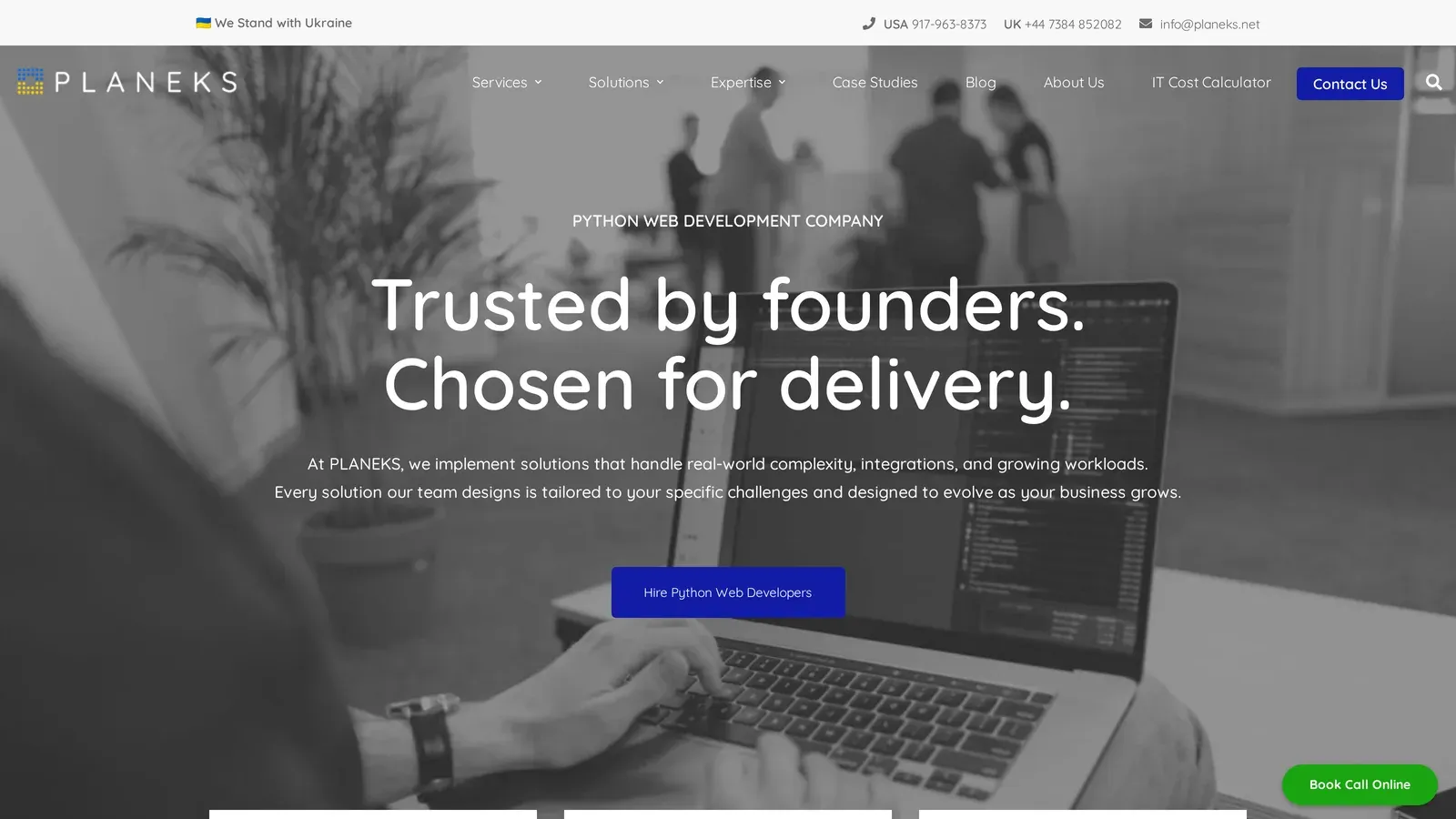
PLANEKS is a Python and Django shop founded in Ukraine, with a London address on its site. Clutch lists Kyiv as its headquarters and rates it 5.0 across 37 reviews, with a $10,000 minimum. Its two named cases appear to be several years old: EuropaFoodXB, a staff CRM and delivery system that exports to DPD, and Wilhelmsen’s Spark app for fleet fuel use. The clearest recent proof comes from Clutch, where Nucar’s president described two internal apps for a car dealership group in August 2025, with about $75,000 spent. PLANEKS publishes cost examples ($15K-$30K for a SaaS MVP with a basic admin panel, $80K+ for an enterprise system with ERP/CRM integrations) and says clients keep the source code and IP. A 2023 reviewer called it their best offshore experience yet, while noting “some gaps around communication and expectations for deliverables.”
Best for: SMEs that want a Python or Django operations system in the $10k-$80k range, with ownership in writing.
3. Magora
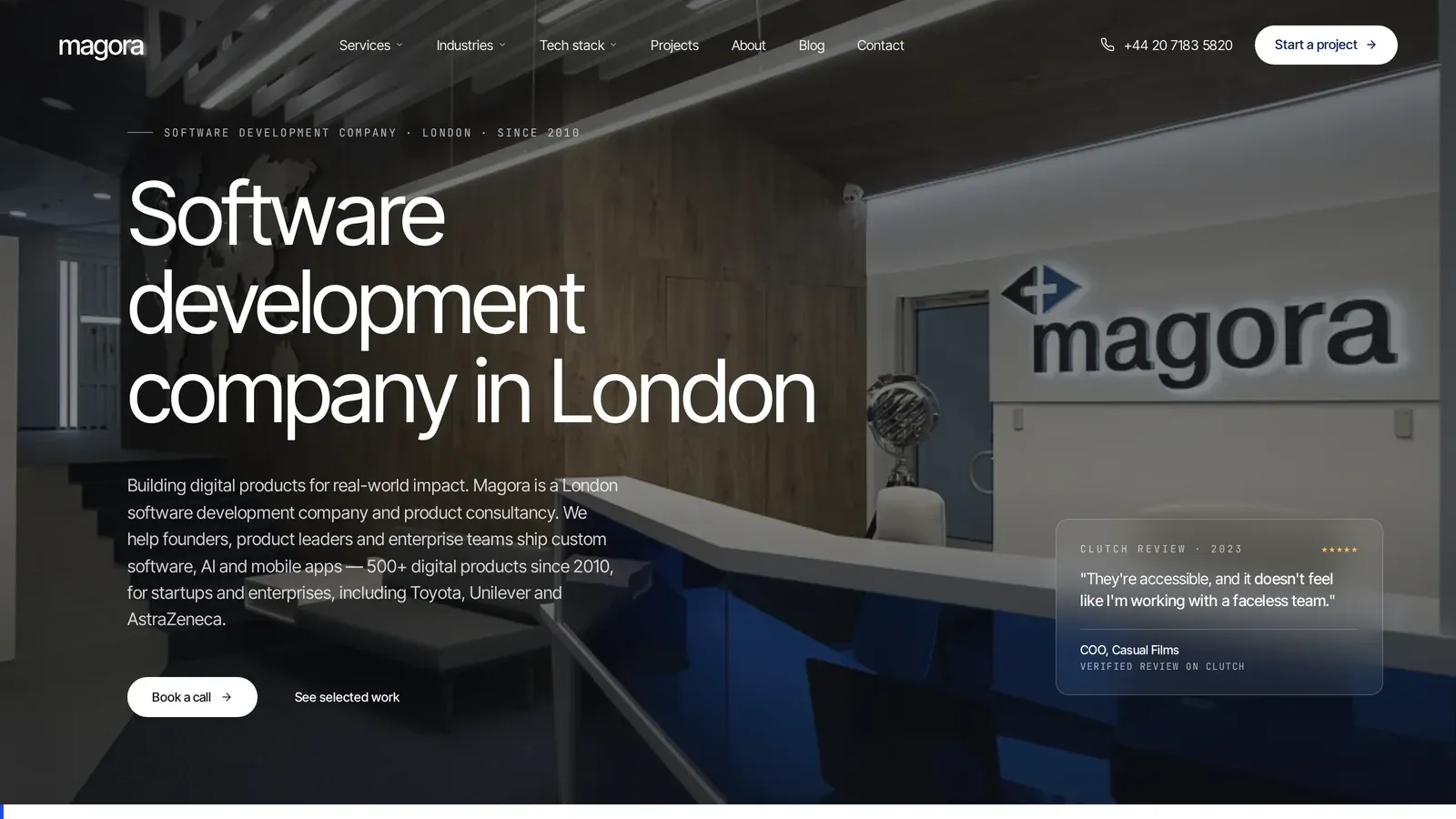
Magora is a London agency that has been in business since 2010, with 50+ engineers, designers, and PMs. Clutch rates it 4.7 across 75 reviews, with a $10,000 minimum. It publishes more pricing than most: a free coded prototype in 5-10 working days, discovery from £3,000, a first release from £10,000, and a full system at £25,000-£60,000. Its FAQ says “source code, designs and IP transfer on payment.” Named internal-tool cases include EGIS’s Pharm Card app, which replaced hundreds of Excel files, and AstraZeneca’s finance dashboards. No case names a connected system, so Magora scores 1 there. Expect real operations systems to cost more than the “from” prices: Clutch’s most common project size is $50,000-$199,999. QA is the recurring complaint in reviews.
Best for: UK SMEs that want published prices, a prototype first, and explicit code ownership.
4. Inoxoft
Inoxoft has five offices, including Philadelphia, Wrocław, Tallinn, and Lviv. Clutch describes it as a 50-249 person team founded in 2014. Clutch rates it 5.0 across 74 reviews (its own homepage still says 50), with a $25,000 minimum and a $25-49 hourly rate. Its internal-tool case studies are all anonymous: a 1C accounting system connected to a custom warehouse system for a US fintech business, a “Smart Enterprise System” for a US logistics company, and a staff portal for an amenity-management company. Its education page says the source code and IP are “yours from day one.” The drawbacks: no named internal-tool client, thin metrics, and a newest Clutch review from November 2025.
Best for: mid-market companies with $25k+ that are willing to rely on Clutch references instead of named case studies.
5. LaunchPad Lab
LaunchPad Lab is a Chicago digital product firm founded in 2012. Its site gives no headcount; Clutch lists 50-249 people. Clutch rates it 4.8 across 44 reviews, with a $10,000 minimum. Its homepage lists “Custom web apps, portals, and internal tools,” and its web app page has an “Internal tools and workflow platforms” section. Named cases include CDK Global’s Sales Discovery Portal for its own field sales reps (“quickly adopted by 80% of the sales team,” with training time cut by more than 90%); a technician and dispatcher app for Total Service Solutions; a staff scheduling tool for Olympus Building Services; and an engine-replacement app for the dealer portal of Kawasaki Engines, which has nearly 7,700 dealers (the company reports a 15% conversion rate on engine replacements added to cart). Salesforce appears in several cases: CDK’s portal feeds discovery data back into Salesforce, Total Service Solutions’ app syncs with it through Heroku Connect, and Rabine’s field-ops app saves to it in real time. The web app FAQ says, “You own the source code, the data, and the intellectual property for everything we build for you.” The drawbacks: the site bills in “credits” and publishes no price, so pricing scores 1 based on Clutch alone, which lists $150-$199 an hour, the same top band as Atomic Object and Razoyo. After a review dated 10 November 2022, there’s nothing until 20 August 2026. Most of its internal-tool work is built around Salesforce and Heroku, and Clutch’s most common project size is $50,000-$199,999.
Best for: US mid-market companies already on Salesforce that want sales, field-ops, or dealer tools connected to the CRM and have $50k or more to spend.
If you’d rather see the plan and a fixed price before choosing a company, a Design & Architecture Sprint costs a fixed €7-15k over two to four weeks. The blueprint is yours to take to any company on this list.
6. Imaginary Cloud
Imaginary Cloud is a product studio founded in 2010, with offices in London, Lisbon, and Coimbra. Clutch rates it 4.9 across 35 reviews, with a $25,000 minimum. It has no internal-tools service, but its named cases include Advania’s Reproduction Process System, built for a service center designed to process one million devices a year; a custom back office for Eurofound’s MPI tool; and an AWS workflow service for Sedna. It also designed, but didn’t build, a back-office app for UNUA, a made-to-measure tailor. The Advania case gives no outcome numbers and refers to its connections only as “existing systems,” so Imaginary Cloud scores 1 there. The budget fit is weak in practice: its own site puts an average web app at $150,000-$400,000. Its Clutch reviews for internal-tool-style work date from 2020 to 2023.
Best for: scale-ups with a six-figure budget that want a design-led EU team to update an operations system.
7. Akveo
Akveo was founded in 2015. Clutch lists Austin as its HQ; its site lists offices in Warsaw and Vilnius. Clutch rates it 5.0 across 31 reviews, with a $10,000 minimum. It has a dedicated Retool page and named cases: E.ON Drive’s charger-monitoring dashboard across 11 countries (screen refresh time fell from over a minute to under 5 seconds, and tickets are created in Salesforce); L’Esperta’s trip-operations app (120 hours a month saved); and a legal-document workflow for UNHCR. Its homepage prices AI work at typically $15K for a proof of concept and from $60k for a production build (3-5 months). The Retool page says to ask for a quote. The site never says who owns the code, costing Akveo a point. It has a Vilnius office, so it competes directly with Idea Link.
Best for: ops teams that want a Retool-first tool, from a small fix to a full production build, with IP terms agreed in writing.
Companies scoring 10
8. Atomic Object
Atomic Object is an employee-owned firm founded in 2001 in Grand Rapids, Michigan. Clutch rates it 4.9 across 52 reviews, at $150-$199 an hour. Its site says projects “usually run 3-18+ months, with a budget of $50k to over $1 million,” which costs it a budget point. Two named cases cover internal systems: the National Center for Drug Free Sport’s SCAN 3, an iPad app plus an admin web app that replaced a decade-old testing system, and Masterpiece Flower Company’s ERP replacement. Neither case names a connected business system. On Clutch, a janitorial company’s CEO said, “We spent around $1.2 million on this project.” The site says, “All the intellectual property (IP) belongs to you.”
Best for: US mid-market companies with $50k or more that want a senior team to replace a legacy ERP.
9. DOOR3
DOOR3 is a New York technology consultancy founded in 2002. Clutch rates it 4.9 across 48 reviews, at $100-$149 an hour with a $25,000 minimum. It has a page for custom web and intranet portals, plus references heavy on intranets: Cadwalader, Wickersham & Taft’s firm-wide intranet for 400 lawyers, PRISM Vision Group’s SharePoint Online intranet, and Stillwell-Hansen’s Access-to-web rebuild. Its internal-tool reviews involve big-ticket projects: Stillwell-Hansen’s VP of Operations wrote, “The project cost over 1 million.” The trade-offs: no published price, ownership is only implied, and four of its five newest Clutch reviews (February 2025 to January 2026) are for design-only work. The fifth is an MVP build for a startup, so there are no recent internal-tool build references.
Best for: law, finance, and healthcare firms that want intranets or an Access-to-web rewrite and can budget well above $25k.
If you’re unsure what to ask these companies for, our Design & Architecture Sprint maps how the work runs today and ends with a fixed build quote.
10. Velvetech

Velvetech is a US firm founded in 2004, with 250+ employees listed on its about page. Clutch rates it 5.0 across 22 reviews, with a $25,000 minimum, but all 22 reviews date from April 2018 to July 2023. Its own site offers better evidence: named back-office cases for US SMEs connected to QuickBooks. KKworx got a Creatio CRM connected to QuickBooks and Microsoft Exchange, while Leider Greenhouses had its 30-year-old plant production system rebuilt as a cloud app. Its FAQ says, “the client owns the intellectual property, source code, and final deliverables.” The gaps: no prices or rates on the site, no page labeled internal tools, and no new Clutch review in over three years for a 250-person firm.
Best for: US SMEs with $25k+ that want a long-running partner to update an ERP or CRM back office.
11. Idea Link
Idea Link is a Kaunas-based software company founded in 2019, with an in-house team of 20+. Clutch rates it 5.0 across 17 reviews, with a $5,000 minimum. It publishes a fixed €7-15k Design & Architecture Sprint, a build floor of €20K-40K, and a written IP transfer clause. Its named internal-tool proof is one case: Open Infra, an operations system with GPS tracking and work schedules for a fiber and electrical infrastructure operator, replacing several disconnected tools. That’s why it scores 1 on proof. A roadside-assistance dispatch system and an insurance partner portal are anonymous, and no case study names an existing system the tool connects to. The qualifying builds run on Bubble and Xano, so you own the app but not portable code. Reviewers asked for more documentation (Open Infra, 2022) and more detailed scoping (Avance, 2024).
Best for: growing SMEs with no developers that want a fixed-price plan before a modular build.
12. Razoyo
Razoyo is a small Texas team (2-9 people on Clutch) founded in 2011. Clutch lists 5.0 across 3 reviews, at $150-$199 an hour. Its pricing page spells things out: a System Spec for a fixed $2,500, a working MVP from $5,000, and a production build from $10,000. It says, “Once fees are paid, you own the code we write for you.” Its named internal-tool case is X10’s inventory system, which uses M2E and Embedded ERP to connect X10’s sales platforms to its factory-order data. No results are published. An anonymous B2B order workflow connects to the client’s legacy Sage ERP. The caveats: most of the portfolio is Magento and BigCommerce e-commerce, all three Clutch reviews appeared within two weeks in September 2026, and one says the project went well past its original estimate, while another notes “sometimes, things just take longer.”
Best for: B2B companies with a legacy ERP that want a small senior team to scope a back-office layer first.
Companies scoring 9 or less
13. HouseofMVPs
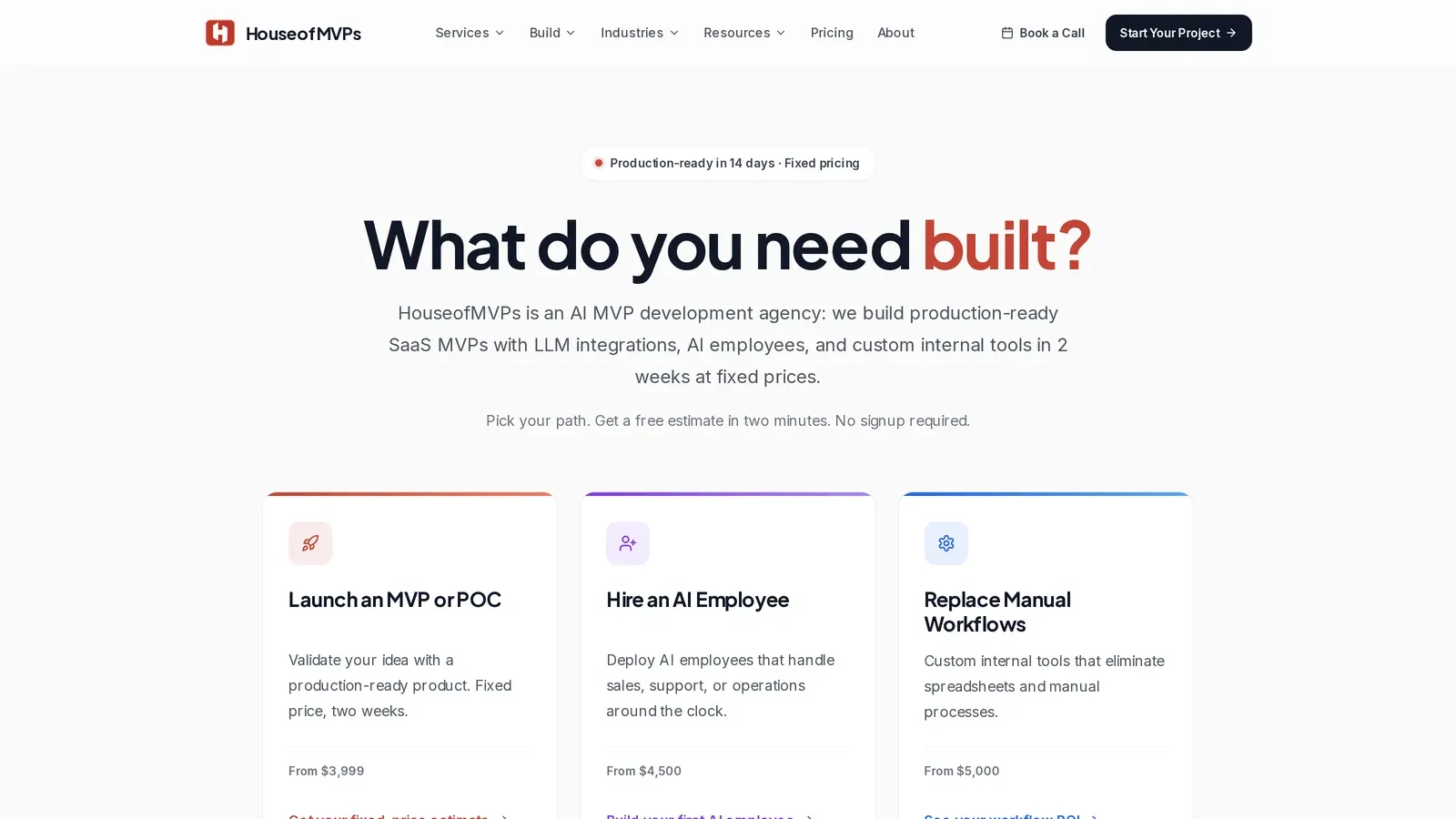
HouseofMVPs has a dedicated internal-tools page with fixed packages: $5,000 (10 days), $12,000 (3 weeks), and $25,000 (4-6 weeks). Each build “ships with full source code ownership.” Its four internal-tool case studies include exact prices and timelines (a custom CRM at $7,499 in 14 days, an inventory system at $12,999 in 18 days), but every client is confidential, so the references can’t be checked independently. The site gives no location or team size. Clutch lists a 2-9 person studio founded in 2020 in Dindigul, India, with a profile that has no reviews. Its mid-tier price differs between pages ($12,000 and $9,000).
Best for: small teams that want one defined tool shipped fast at $5k-$25k and don’t need references before signing.
A fixed-price Design & Architecture Sprint ends with screens, architecture, and a quote you can show to any of these companies, including ours.
14. Stackdrop
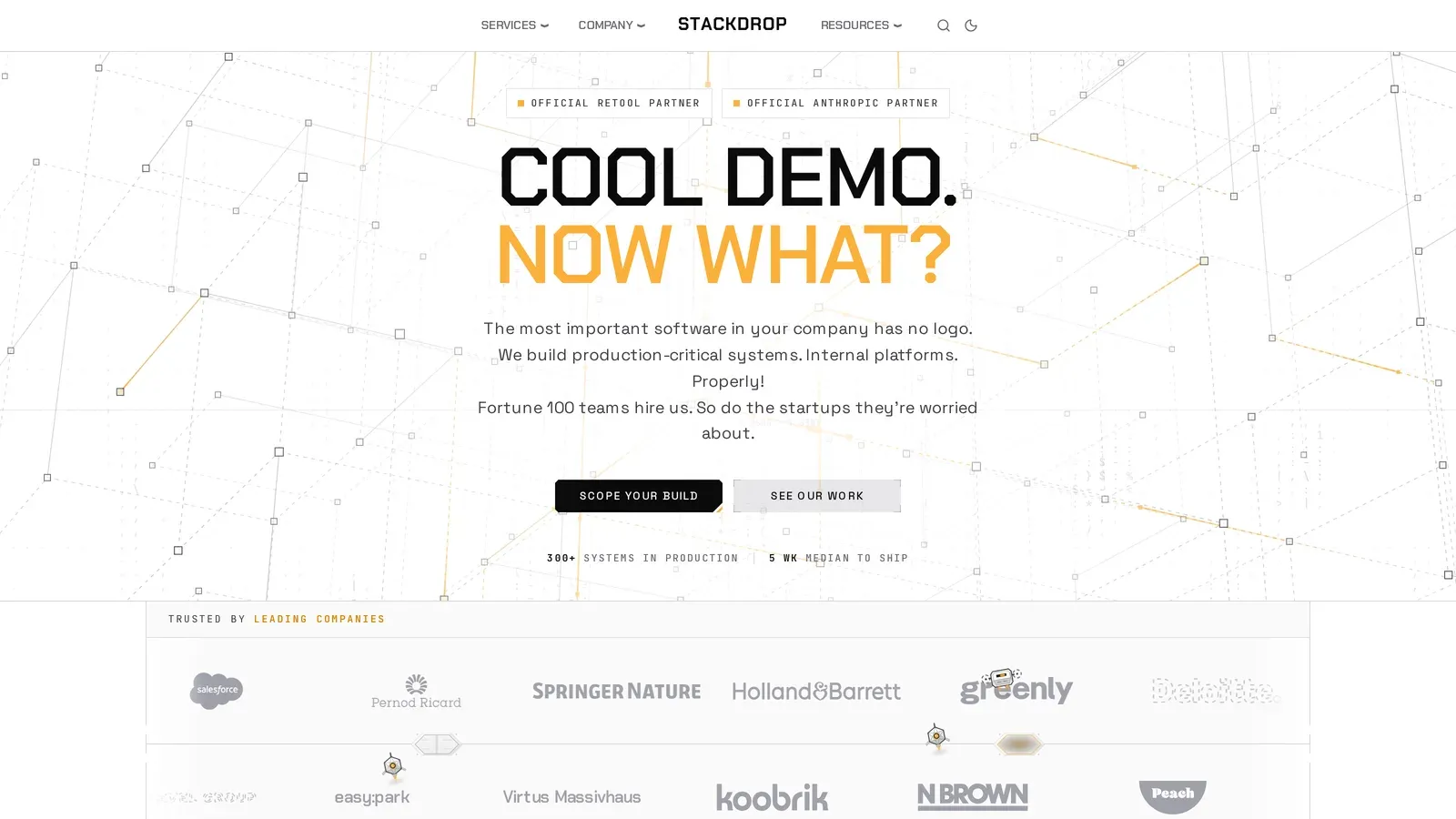
Stackdrop opens its homepage with internal tools (“Admin panels, portals and ops consoles”) and builds on Retool. It lists 20+ specialists and, according to Clutch, was founded in 2022 and is based in Kallithea, Greece. Its Clutch profile has no reviews. Saxo Bank’s Launchpad is a governed Retool platform for in-house creative operations, connected to Zuuvi, Bynder, and Podio. Saxo’s own analysis shows average project duration falling from 310 hours to 67. Stackdrop claims its median time to ship a first build is 5 weeks across 200+ internal tools. The gaps: it publishes no prices or minimums, which is why it scores 0 on both, and has no public reviews. Its ownership wording (“Your logic in your repo”) is plain English, not contract language.
Best for: regulated UK and EU teams that want a governed Retool build and are willing to check references themselves.
15. Bold Tech
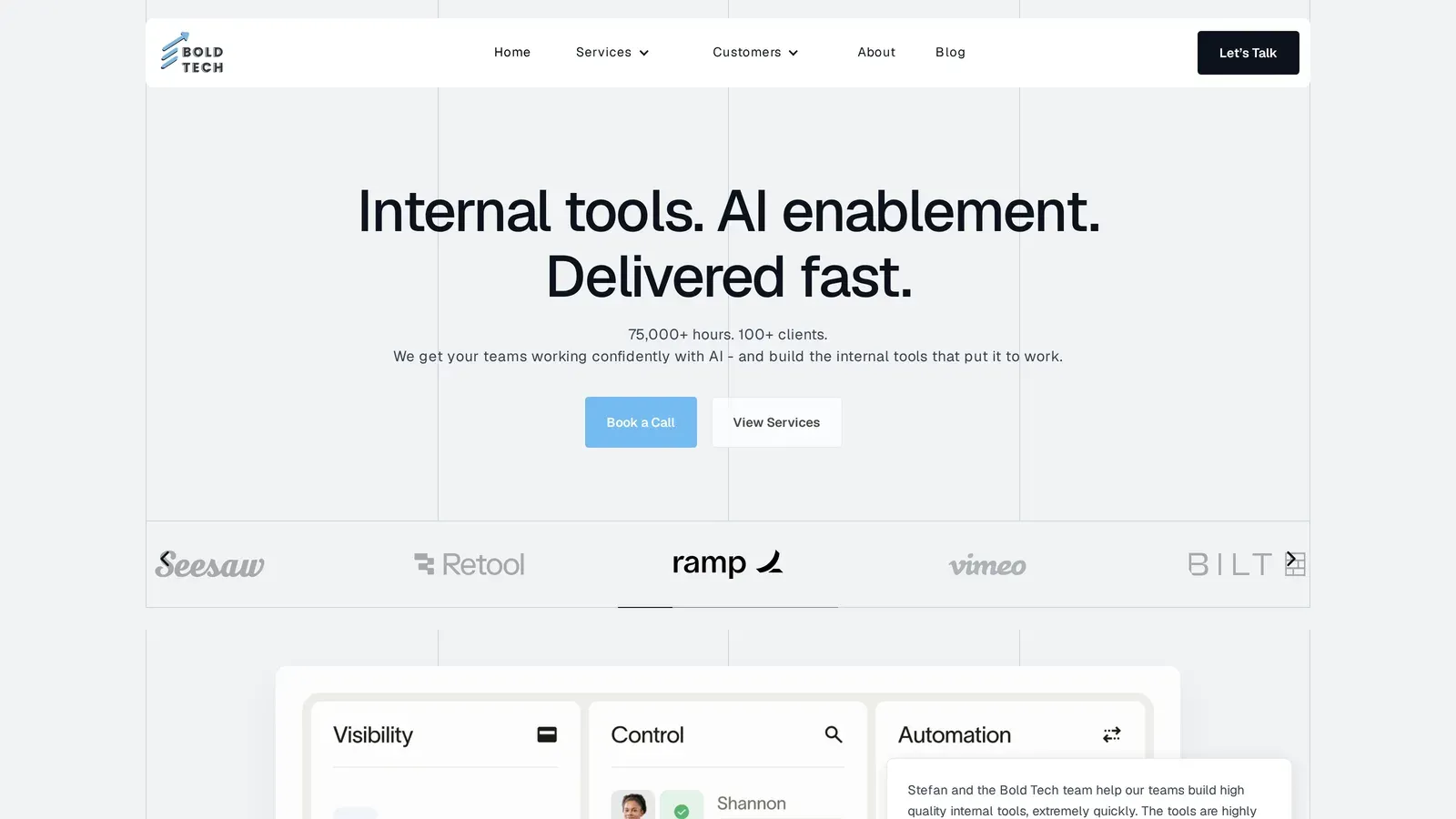
Bold Tech specializes in Retool. Its about page says it has spent 80,000+ hours on internal tools since 2020 and profiles 12 people, with no address. We found no Clutch profile for it. The “Bold Tech” profile in Winter Park, Florida links to boldtech.co, and its reviews, from 2013 to 2019, cover websites and mobile apps, so we didn’t count them. Its blog has named customer stories: Chegg Skills (internal Retool apps saving 80 hours a month on average), Vimeo (about 200 hours a quarter for one team), and One More Time VIP, a Retool operations database connected to NetSuite. The gaps: no prices, minimums, or ownership statement, though its services page says each engagement “ends with a clean handoff.”
Best for: teams already on Retool that want a specialist to connect apps to systems such as NetSuite.
How to choose between them
Start with who will use the tool and what it needs to connect to. If the finance team uses it daily and it reads from QuickBooks, look for a company with a named QuickBooks project. Velvetech has one (KKworx). Itransition has comparable cases for Dynamics 365 and Odoo, and LaunchPad Lab for Salesforce (CDK Global). Then check five things.
- Named clients. Eleven of the 15 name two or more internal-tool clients. Ask to speak with one.
- Review dates, not just ratings. Every rated company sits between 4.7 and 5.0. Velvetech’s newest review is from July 2023, Inoxoft’s and Idea Link’s from November 2025, and LaunchPad Lab’s 44 reviews jump from November 2022 to August 2026.
- Connections, named and written into the scope.
- Code ownership, and whether the code can leave the platform it runs on.
- A fixed price for a scoped first step. Ten of the 15 publish some price on their own sites. DOOR3, Velvetech, and LaunchPad Lab list one only on Clutch, while Stackdrop and Bold Tech publish none.
Build in-house when you already employ the developers and the tool is central to what you sell. For a team with no engineers, the Exclaimer numbers above are a reason to be careful.
What internal tools cost
These are prices published by the companies, in their own currencies, checked on 27 October 2026. Most are “from” prices.
- Razoyo: spec $2,500 fixed, MVP from $5,000, production build from $10,000.
- HouseofMVPs: fixed packages from $5,000.
- Magora: discovery from £3,000, a full system at £25,000-£60,000.
- Idea Link: Sprint at a fixed €7-15k, builds from €20K-40K, up to €100k+.
- PLANEKS: $15K-$30K for a SaaS MVP with a basic admin panel, $80K+ for an enterprise system with ERP/CRM integrations.
- Akveo: AI work at typically $15K for a proof of concept, from $60k for a production build. Its Retool page quotes on request.
- Atomic Object: $50k to over $1 million. Imaginary Cloud: an average web app at $150,000-$400,000.
Clutch hourly bands run from $25-49 (Itransition, PLANEKS, Inoxoft) to $150-199 (Atomic Object, LaunchPad Lab, Razoyo). LaunchPad Lab publishes no prices and bills in credits. Treat “from” figures as floors: Magora’s most common reviewed project is $50,000-$199,999. Then there’s the bill after launch. In Exclaimer’s survey, 63% of teams spend 10-50 hours a month maintaining internal tools, and 66% need an additional $20,000 to $100,000 a year to keep them running. Exclaimer sells software, so keep that in mind when reading the numbers.
About Idea Link
Idea Link is a Lithuanian software company founded in 2019, with offices in Kaunas and Vilnius. Our in-house team of 20+ has shipped 100+ digital and AI projects, and we have a 5.0 rating on Clutch across 17 reviews. Start with Open Infra: an operations system for a fiber and electrical infrastructure operator that replaced several disconnected tools. Before any build, we offer the Design & Architecture Sprint, a fixed €7-15k engagement. You own the designs and code, with no license fees. Read more on our services page.
Frequently asked questions
What does an internal tools development company do?
It builds the software your own staff use to run the business: back-office and operations systems, admin panels, internal dashboards, and staff or partner portals. The better companies also connect the tool to systems you already use, such as QuickBooks, Salesforce, or an ERP, and hand over the code and documentation. Retool is different: it’s a platform you build on yourself.
How much does a custom internal tool cost?
Published starting prices on this list range from a fixed $2,500 spec (Razoyo) and $5,000 packages (HouseofMVPs) to $50k and above (Atomic Object). Magora lists £25,000-£60,000 for a full system, while PLANEKS lists $15K-$30K for a SaaS MVP with a basic admin panel. Ask for a fixed quote after scoping. “From” prices are floors.
Should I use Retool or hire a company?
Use a platform if one team needs a simple tool with one or two data sources and someone on staff will own it. Hire a company when the tool needs to connect to an ERP or accounting system, has many roles and permissions, or must outlast its builder. At Retool’s list prices, 5 builders and 100 internal users on Business cost $21,000 a year in licenses.
Who owns the code of an internal tool?
It depends on the contract, so get the terms in writing. Twelve of the 15 companies state on their own sites that the client owns the code, though Stackdrop uses plain repo-and-handover terms rather than IP language. Akveo, DOOR3, and Bold Tech only imply ownership. On Bubble, which Idea Link uses for much of this work, you own the app but can’t export the code.
How long does an internal tool take to build?
Anywhere from days to months. HouseofMVPs lists 10 days to 6 weeks for its fixed packages, Magora lists a coded prototype in 5-10 working days, and Stackdrop reports a median first build of 5 weeks across 200+ internal tools. Akveo lists 3-5 months for an AI production build. A two-to-four-week Design & Architecture Sprint comes before a build.
The first step
If your operations live in Excel, in emails, or in someone’s head, and you’d rather see the plan and price before choosing a build partner, start with our Design & Architecture Sprint: a fixed €7-15k over two to four weeks that ends with a process map, architecture, screens, and a fixed build quote. You own all of it, whether you build with us or not.
Related reading
- The best custom software development companies
- The best software development companies
- Nearshore software development companies
- The best AI agent development companies
- The best software development companies in Lithuania
- AI adoption statistics
- Our services
What changed in this update
- 29 October 2026: added a related-reading link.
- 27 October 2026: first published.