
![The 14 Best AI Agent Development Companies [2026]: Enterprise vs. Mid-Market — Idea Link](/_next/image?url=https%3A%2F%2Fcdn.idealink.tech%2Fcover-8.webp&w=3840&q=75)
Fourteen AI agent development companies in two tiers, the enterprise five ChatGPT names and nine mid-market specialists scored on six criteria, with Clutch data checked in October 2026.
At a glance
| Company | Tier | HQ | Best for | Team size | Clutch |
|---|---|---|---|---|---|
| 10Clouds | Mid-market | Warsaw | Agents in financial services | 50-249 | 4.9 (95 reviews) |
| Azumo | Mid-market | San Francisco | Nearshore agents and app development | 50-249 | 4.9 (27 reviews) |
| Vstorm | Mid-market | Wrocław | Agents with evals | 40+ | 4.9 (22 reviews) |
| Idea Link | Mid-market | Kaunas and Vilnius | Agents inside operational software | 20+ | 5.0 (17 reviews) |
| STX Next | Mid-market | Poznań | Large pool of Python developers | 450+ | 4.7 (103 reviews) |
| Netguru | Mid-market | Poznań | A priced workshop start | 400+ | 4.8 (73 reviews) |
| Boldare | Mid-market | Gliwice | Fixed-price PoC sprints | 100+ | 4.8 (63 reviews) |
| Neurons Lab | Mid-market | London | Financial services on AWS | 50+ | 5.0 (5 reviews) |
| JADA Squad | Mid-market | Dubai | Back-office agents | 10-49 | 5.0 (3 reviews) |
| Accenture | Enterprise | Dublin | Cross-functional programs | ~814,000 | No profile found |
| Deloitte | Enterprise | London | Ready-made finance and back-office agents | ~500,000 | No profile found |
| Cognizant | Enterprise | Teaneck, NJ | Regulated IT operations | 356,700 | No profile found |
| HCLTech | Enterprise | Noida | IT engineering and operations | Over 230,000 | No reviews |
| Capgemini | Enterprise | Paris | Supervised agents in Europe | 417,600 | 3.0 (1 review) |
Ask ChatGPT to name the best AI agent development companies. In our October 2026 test, it named Accenture, Deloitte, Capgemini, Cognizant, and HCLTech. The answer makes sense for a Fortune 500 buyer. It is less useful for a 200-person company trying to put one agent into a real workflow. Accenture's mid-market division serves companies with annual revenue of $300 million to $3 billion; HCLTech's starts at $500 million.
That leaves a large gap between companies buying multi-year programs and teams looking for a focused agent development partner. The distinction matters: Gartner predicts that more than 40% of agentic AI projects will be canceled by the end of 2027, particularly because of rising costs, unclear business value, or inadequate risk controls. A smaller, well-scoped agent project may be easier to assess than a program spanning several business functions. It still needs sound software, reliable data, clear systems integration, and an owner.
This list covers nine mid-market development companies and five enterprise firms. It is for operations, finance, and product managers considering agents for specific business workflows, not for anyone collecting AI vendor logos. The best AI agent development companies for a buyer depend on the work, budget, and whether the agent needs to live inside existing software and systems. Below, the AI agent development companies are grouped by tier, with evidence and tradeoffs laid out company by company.
Disclosure: Idea Link wrote this list and is on it. Every mid-market company, Idea Link included, was scored on the same six criteria using public data checked on 16 October 2026.
Best pick by use case
| If you need... | Best pick | Why |
|---|---|---|
| An agent inside custom operational software, without an in-house development team | Idea Link | Idea Link built the QualifyHQ platform, which qualifies companies on 100+ data points, and the DataIst platform. Both have agents inside. |
| The lowest entry threshold | Idea Link | A $5,000+ Clutch minimum, the lowest among the nine companies. |
| Agent evaluations and workflow tracking | Vstorm | A dedicated page on evaluation suites rerun in CI. |
| Nearshore rates | Azumo | $25-$49 per hour on Clutch, the lowest rate listed. |
| Agents for financial services workflows | 10Clouds | Collaborations with Polfund, PZU, and BNP Paribas Bank Polska. |
| A financial services partner on AWS | Neurons Lab | AWS AI Competency in the "Agentic AI" category. |
| A paid agent development workshop | Netguru | The "AI Agents Workshop" costs EUR 3,000 for 3-6 hours. |
| A one- to two-week fixed-price proof of concept (PoC) | Boldare | The sprint fee is credited toward the build if you continue. |
| A large pool of Python specialists | STX Next | Over 450 specialists and 103 Clutch reviews. |
| A multifunctional enterprise program | Accenture, Cognizant, or Deloitte | AI Refinery, over 350 reusable agents, and over 1,000 predefined agents. |
What counts as an AI agent
Vendors now routinely label AI products "agent-based." Gartner estimates that only about 130 of the thousands of vendors selling agent-based AI are legitimate. For this list, an agent-based system analyzes business data, takes actions in other systems, and runs multi-step workflows without asking a person to approve every step. These agentic systems connect to the software and operational systems where the work happens.
That differs from a chatbot that answers prompts or workflow automation that follows fixed rules. Autonomous agents can act across several steps, but they still fail roughly one in three attempts in structured performance tests, according to the Stanford AI Index 2026. So most of the builds below leave final approval to a person. That is not a failure of ambition. It is a sensible way to put an agent into a business system without pretending the agent has stopped being software.
How we chose and scored them
The mid-market firms are entries 1-9. Each received 0, 1, or 2 points across six criteria, for a maximum of 12, based on Clutch profiles and company websites. The scores stick to information a buyer can check. A 0 means the company has not published the information.
The enterprise firms are entries 10-14. They are not scored. We ordered them by named commercial agent deployments and published agent assets. None publishes a minimum engagement, which makes it hard for a buyer to compare budgets on equal terms. Capgemini is last because its identified deployments are nonprofit and United Nations projects: UNICEF and UNESCO.
- Real agents. 2 points for a case study with an identified client showing autonomous agents taking actions or running multi-step workflows; 1 for AI case studies without agents or with unnamed agents; 0 for a basic services overview.
- Proof. 2 points for 15 or more Clutch reviews, with the newest under 12 months old; 1 for 3-14 reviews or older reviews; 0 for fewer than three.
- Budget fit. Clutch minimum project size: 2 points for $10,000 or less; 1 for a stated amount up to $50,000; 0 for more than that or no published budget.
- Speed. 2 points for a published pilot or kickoff timeline measured in weeks; 1 for a discovery phase or workshop without a defined pilot duration; 0 for nothing published.
- Full system. 2 points for published custom software development beyond AI, including back-end, integration, and interface work; 1 for work focused only on AI and data.
- Agent ops. 2 points for a published approach to agent evaluation and monitoring, plus official partner status relevant to agents; 1 for either; 0 for neither.
Four firms are tied on 11 points, and the review-count tiebreak sets their order.
| Company | Real agents | Proof | Budget fit | Speed | Full system | Agent ops | Total |
|---|---|---|---|---|---|---|---|
| 10Clouds | 2 | 2 | 1 | 2 | 2 | 2 | 11 |
| Azumo | 2 | 2 | 2 | 2 | 2 | 1 | 11 |
| Vstorm | 2 | 2 | 2 | 2 | 1 | 2 | 11 |
| Idea Link | 2 | 2 | 2 | 2 | 2 | 1 | 11 |
| STX Next | 1 | 2 | 1 | 2 | 2 | 2 | 10 |
| Netguru | 2 | 2 | 1 | 1 | 2 | 2 | 10 |
| Boldare | 1 | 2 | 1 | 2 | 2 | 1 | 9 |
| Neurons Lab | 2 | 1 | 0 | 2 | 2 | 2 | 9 |
| JADA Squad | 2 | 1 | 2 | 2 | 1 | 1 | 9 |
We also assessed N-iX (8) and LeewayHertz (7), then left both off the list. N-iX has more than 2,400 engineers and a Clutch minimum project size above $100,000, which puts it outside the mid-market segment. LeewayHertz's newest Clutch review is from 2019, and The Hackett Group now owns the company.
Mid-market AI agent development companies
These nine specialists direct their business development toward companies smaller than large enterprises. They rank by score, with Clutch review counts breaking ties. Their work ranges from custom software with an agent inside to narrowly focused agent development. The differences show up in minimum budgets, published timelines, and how much proof a buyer can inspect before choosing a partner.
1. 10Clouds
10Clouds is a Warsaw-based software development company that now focuses its agent development work on financial services. Clutch rates it 4.9 across 95 reviews and lists a minimum budget above $25,000.
For Polfund, SmartLead AI runs a five-step workflow. It collects tender notices, filters them, and enriches them with public-record data before the team decides what to do. A proof of concept (PoC) for credit scoring at an unnamed Polish bank saved analysts more than 100 hours of work per month on the tested portion. A typical PoC takes 4-6 weeks, and most agent projects are still at an early stage.
Best for: financial services companies, including banks, insurers, and fintech firms, that want agents to handle credit, bidding, or sales workflows with a team that can also develop complete products.
2. Azumo

Azumo is a San Francisco-based software development company founded in 2016. Its agent development team works nearshore in Latin America. Clutch rates the company 4.9 across 27 reviews, lists an hourly rate of $25-$49, and sets a minimum project cost of $10,000+.
Its agent for Angle Health handles a quote workflow. It reads Zendesk ticket emails, extracts the data needed for a quote, and drafts one for underwriting approval. The service provider says this cut the proposal cycle from 45 minutes to 5. The "Starter" plan targets MVPs and PoCs at $899 per delivered unit. Reviews mention staff turnover during the project, and we found no partner status.
Best for: budget-conscious teams looking for a nearshore team to develop an agent and its supporting custom application.
3. Vstorm
Vstorm is an agent development company in Wrocław with more than 40 employees. It specializes in agent systems built into clients' products. Its Clutch profile shows a rating of 4.9 across 22 reviews, a minimum project size of $10,000, and this category's highest hourly rate, at $100-$149.
Its Mixam case study describes a three-agent system with 15 tools. The system guides a new user from an initial order description to a valid, printable purchase order. Vendor-reported figures say Mixam's conversion to sale rose from about 20% to about 40%. Vstorm is an OpenAI Select partner and an Anthropic Claude Certified Services Partner. It typically delivers its first "Proof of Value" in about three weeks.
Best for: product companies that want an agent shipped inside an existing product, with evaluation suites rerun in CI (continuous integration) on every change.
4. Idea Link
Idea Link develops custom business software and adds agents where they can save time in day-to-day operations. Founded in 2019, it has offices in Kaunas and Vilnius and an in-house team of more than 20 people. Clutch rates it 5.0 based on 17 reviews, and its minimum project cost is $5,000+.
Idea Link built the QualifyHQ platform, which identifies similar companies using more than 100 data points, with email-address accuracy above 95%, according to the vendor. It also built DataIst, whose agents draft GDPR-related documents for experts to review. Its agent development page gives a 2-4-week turnaround for simple agents.
Idea Link is tied on 11 points with three other firms and placed fourth among them by Clutch review count. Its weak spot is clear: no official partner status relevant to agents, so agent ops scores 1.
Best for: a fast-growing company without an engineering team that needs an agent built into its operational software.
5. STX Next
STX Next is a software development company in Poznań, founded in 2005, with more than 450 specialists. Clutch rates it 4.7 out of 5 across 103 reviews, the largest review count on this list, and lists a minimum budget above $50,000.
Its AI agents page lays out a 12-week plan, with the first automation typically running within 6-8 weeks. The company is an AWS Advanced Tier, Snowflake, and Databricks partner. Its agent development record is thinner: the Permira case is an n8n training program, while the logistics routing agent is anonymous.
Clutch reviews read like those of a long-term Python team-extension partner. The recurring complaint is that replacing team members is slow. That may matter if the software depends on a stable team that understands the system and its workflows.
Best for: companies on AWS or Azure that want a large Python team to build a complete custom system.
6. Netguru
Netguru is a software development company in Poznań, founded in 2008, with more than 400 employees. Clutch rates it 4.8 based on 73 reviews and lists a minimum project cost of $50,000. Its Clutch profile puts custom software development front and center.
The company's paid starting offer is the "AI Agents Workshop", priced at EUR 3,000 for 3-6 hours. Its flagship agent projects are a claims-processing agent for ARC Europe and a chemical-data pipeline for Merck KGaA. Both were proofs of concept lasting five to six weeks. No production rollout is reported. Netguru is a Microsoft Gold Partner, and reviewers give cost its lowest sub-score.
Best for: buyers at medium-sized and large companies who want an introductory agent workshop and have a large team ready to develop a custom product.
7. Boldare
Boldare is a software development company in Gliwice, founded in 2004, with more than 100 employees. Clutch rates it 4.8 across 63 reviews and lists a minimum project value of $25,000. Custom software development is the largest share of its Clutch work.
Agent development starts with a fixed-price AI Opportunity Sprint: one week for a feasibility study and integration mapping, then two weeks for a full PoC. The sprint fee is credited toward the build if you continue. A typical next phase, building an AI feature with a defined scope, takes 4-8 weeks.
Its strongest agent work is an anonymized proof-of-concept assistant built in 2023. It creates trade listings and processes transactions on a trading platform. We found no partner status. Reviewers praise Boldare's Scrum process, though none mention AI.
Best for: product companies that want to start with a fixed-price proof-of-concept (PoC) sprint, then build a full product team.
8. Neurons Lab
Neurons Lab is a London-based AI development company with an office in Singapore. Founded in 2019, it has more than 50 employees. Its dAppForge is an "agentic AI copilot" for smart-contract code. It runs a cycle of generation, evaluation, and retrying. The vendor says it cuts development time by 50%.
In June 2026, Neurons Lab earned AWS AI Competency certification in the "Agentic AI" category. It also has OpenAI Select partner status, and a PoC typically takes 2-4 weeks. Clutch rates it 5.0 across 5 reviews; the newest review dates from 2022 and is not about an agent. Its FAQ lists $20,000-$50,000 for rapid PoCs, while Clutch lists a minimum above $100,000. The company focuses on financial services, though several cited bank examples concern training programs.
Best for: banks, insurers, and fintech companies on AWS that want agents for regulated financial services.
9. JADA Squad
JADA Squad is an AI agent development company founded in Dubai in 2024, with 10 to 49 employees. It works exclusively on agents and grew out of a BI and data consulting firm.
For Tancredi, JADA Squad runs five agents in the client's Azure environment and reports a 46% time saving in production. A verified Clutch review cites the same 46% figure. Clutch rates the company 5.0 across 3 reviews and lists a minimum project value of $10,000.
The drawbacks: the website says nothing about executives, most other agent use cases are anonymous, and partner badges are unverified. The Tancredi reviewer, the client, said they underestimated how much internal feedback the project would need.
Best for: teams that want a small, agent-only shop to automate a back-office workflow such as procurement, PR, or HR operations, from about $10,000.
Enterprise AI agent development companies
These five firms sell agent platforms, ready-to-use agent libraries, and multi-year programs. The platforms and agentic systems are real. Their pricing is not public. None discloses pricing or minimum contract terms, so buyers cannot check the budget fit before opening a sales conversation. That may suit a company running a broad agent development program across business functions. A team looking for one agent in one workflow may find a specialist easier to assess.
10. Accenture
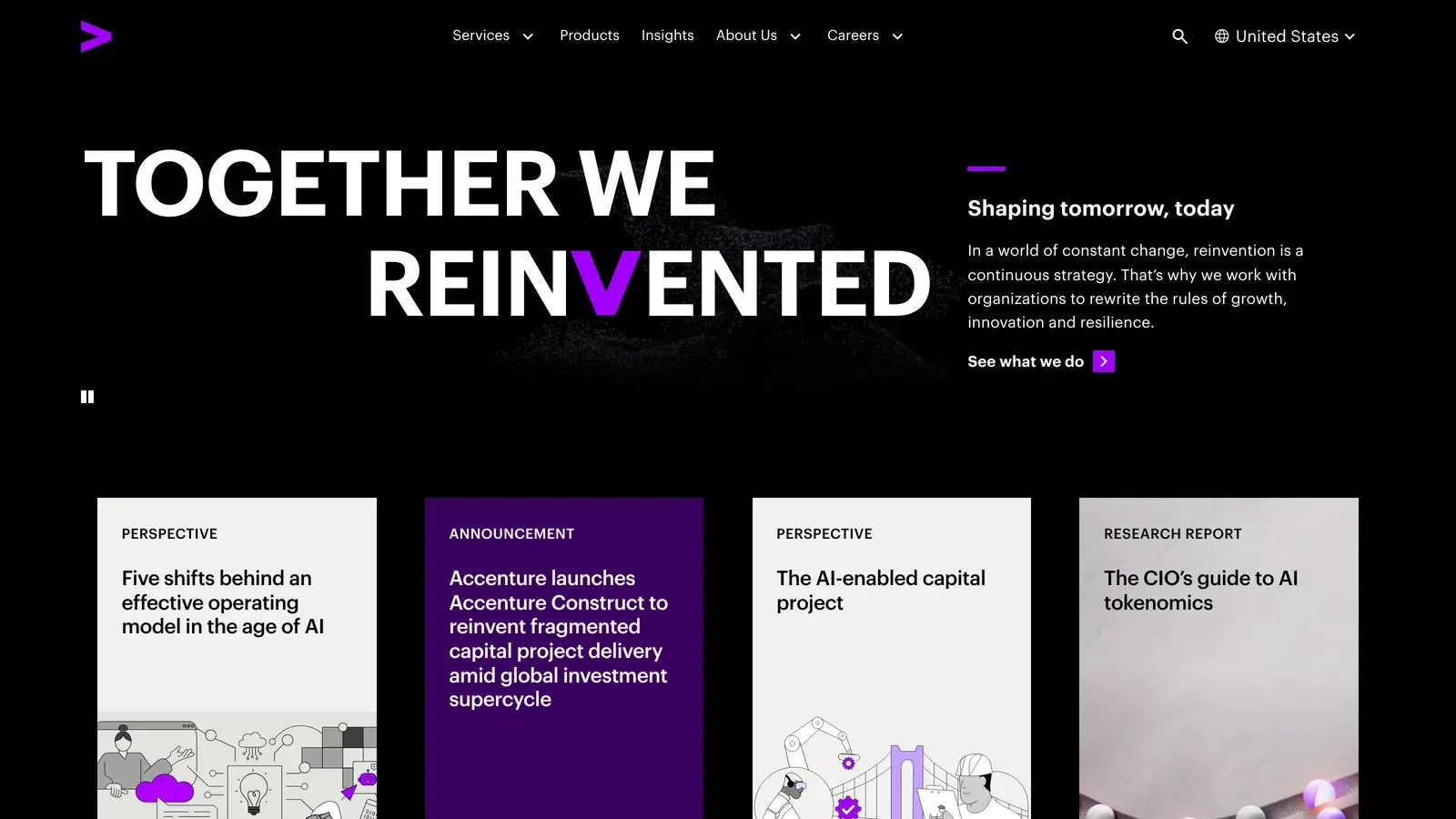
Accenture, headquartered in Dublin, has approximately 814,000 employees. Its agent development platform, AI Refinery, runs on NVIDIA and includes a "no-code" agent generator. At Repsol, custom autonomous agents handle workflows such as planning, forecasting, and incident resolution. The HPE and United Nations projects remain under development.
Accenture Edge serves mid-market companies with $300 million to $3 billion in annual revenue. That is the firm's own definition, not the one a 200-person company might use after a particularly optimistic planning session.
Best for: large companies planning an agent program across several business functions, with partners such as NVIDIA, Google Cloud, and ServiceNow.
11. Deloitte
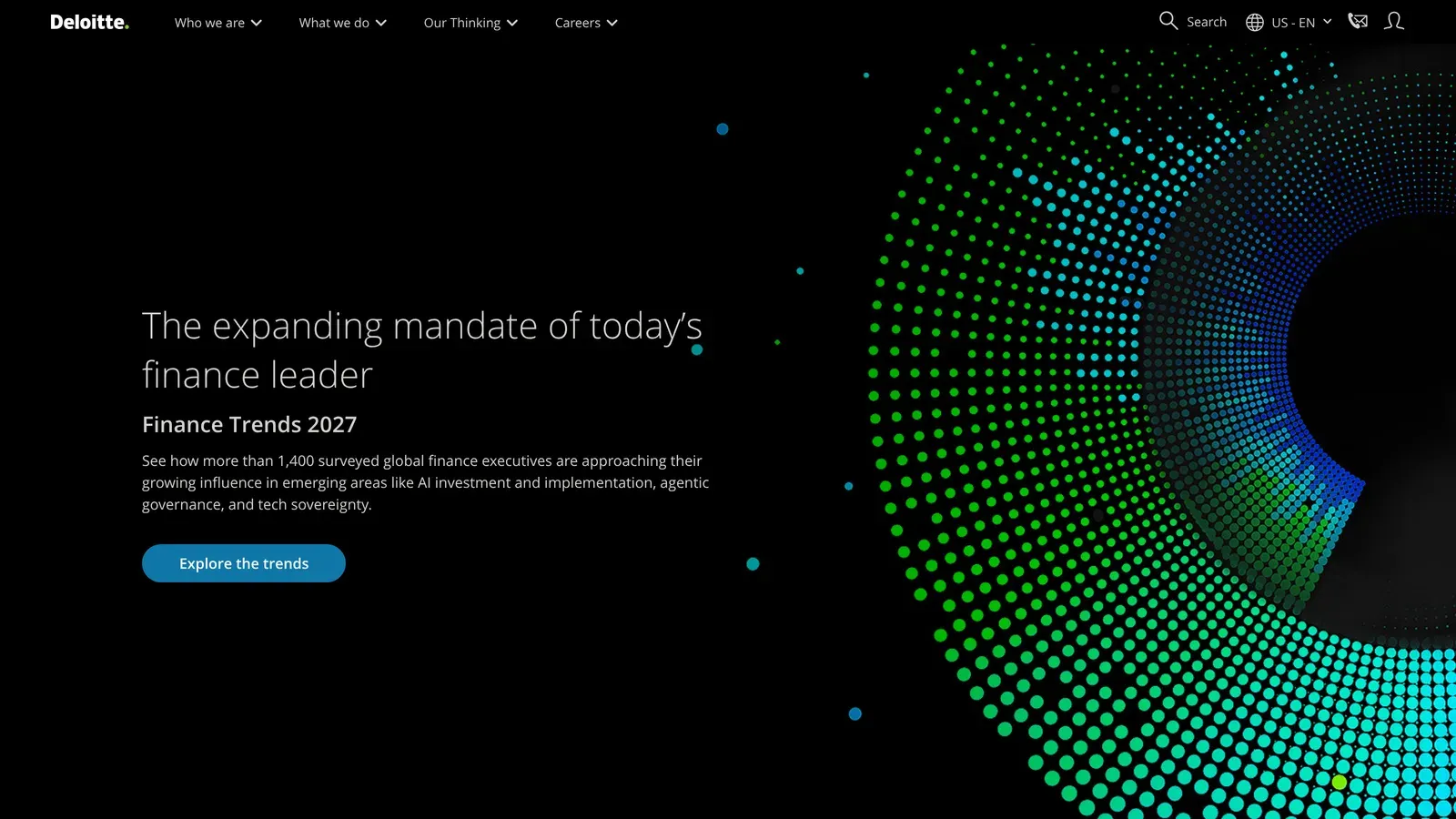
Deloitte is a network of member firms coordinated from London, with nearly 500,000 employees. Its agent development product, Zora AI, is a cloud subscription suite of ready-to-use autonomous agents for finance, supply chain, procurement, sales, and customer service. It includes more than 1,000 predefined industry-specific agents.
HPE uses Zora AI to analyze financial statements and plans to halve reporting time. That is a projection, not a reported result. The distinction matters when an agent is being sold on a business case rather than a demo.
Best for: companies seeking ready-made agents for back-office workflows on SAP, Oracle, Google Cloud, or Salesforce, with Deloitte's audit expertise.
12. Cognizant
Cognizant is headquartered in Teaneck, New Jersey, and employs 356,700 people. Its agent development offering, Agent Foundry, pairs autonomous agents and other agent-based systems with deployment services. Cognizant says it has more than 350 reusable agents.
For an unnamed British investment firm, Cognizant developed agentic reviewers to check content against FCA requirements, cutting validation from several weeks to a few minutes. A five-year partnership with Novartis covers outsourced IT operations using AI, automation, and agent capabilities. The fit is clearest when the agent sits inside a larger services contract.
Best for: regulated sectors such as life sciences, financial services, and healthcare, where agents sit within large IT management contracts.
13. HCLTech
HCLTech, headquartered in Noida, India, employs more than 230,000 people. Its agent development platform, AI Force, automates and improves workflows in software and data engineering, IT operations, and business processes. It combines predefined agents with an "Agentic Studio," where users can create custom agents for their systems.
The identified agent contract is a seven-year agreement with Guardian, an insurer in the financial services sector. HCLTech Pulse, its unit for growth-stage companies, targets businesses with revenue between $500 million and $5 billion.
Best for: companies focused on agents and automation in software engineering, IT operations, and application modernization, often through managed services contracts.
14. Capgemini
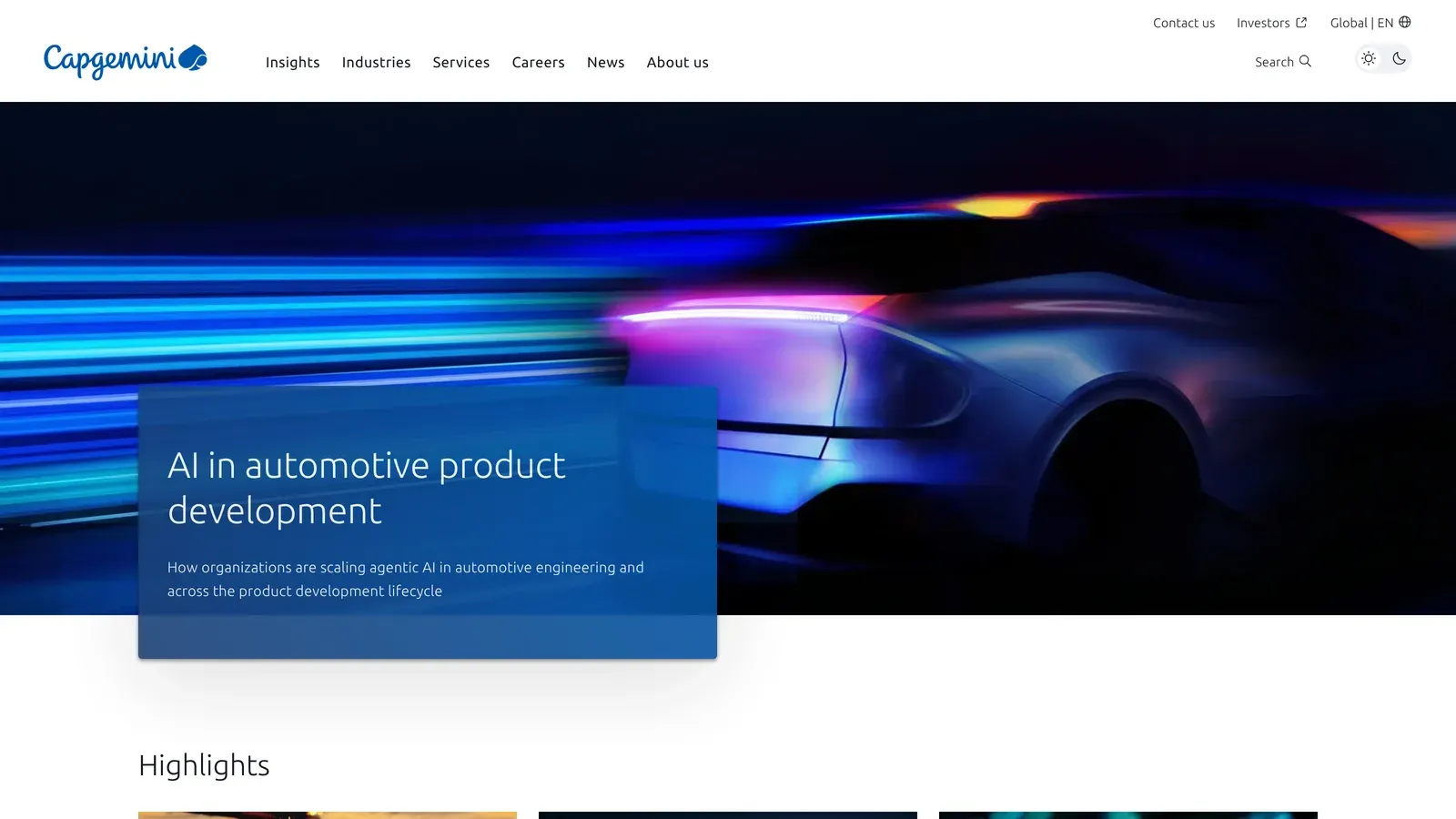
Capgemini, headquartered in Paris, has 417,600 employees. Its agent development offering, Agentic AI for Enterprise, includes ready-to-use, customized, and embedded agents on RAISE, its governance and monitoring layer for agentic systems.
The cited agentic systems serve nonprofit organizations: a career guidance assistant from UNICEF for 16- to 24-year-olds in Brazil, still in testing when announced, and an educational policy tool from UNESCO. Capgemini's 2026 announcements say very little about commercial clients.
Best for: European companies and regulated industries that want agents managed across several clouds and models, including Mistral AI.
Enterprise or mid-market: how to decide
Start with revenue. Below $300 million, a company falls outside the mid-market ranges Accenture and HCLTech define, and none of the five enterprise firms publishes a minimum engagement amount. Above that threshold, a company needing agents across several business functions, with partner infrastructure already in place, may need a large program. For a narrower workflow, a specialist may be the more practical partner.
Speed tends to favor mid-market firms. MIT NANDA found that the top-performing mid-market companies moved from pilot to full deployment in about 90 days, compared with nine months or more for large companies. External partnerships led to deployment in about 67% of cases, compared with about 33% for in-house development. Both figures are self-reported and concern generative AI (GenAI) broadly, not agentic AI alone.
Code ownership can determine how long an agent remains useful. Gartner predicts that by 2028, 70% of companies will abandon agentic AI built by a vendor's forward-deployed engineers. The prediction describes companies unable to change those systems themselves and facing sharply rising costs. Ask who owns the custom code and whether your team can change it without the development company.
Start with one or two workflows and data you already trust. Typical first workflows include intake, document drafting, and lead qualification. If a task follows fixed rules, basic automation costs less than an agent. In financial services, ask who checks the agent's behavior. At 10Clouds, the client's compliance team approves it before launch. Ask every company for a concrete case study before choosing a partner.
About Idea Link
Idea Link is a Lithuanian software development company founded in 2019, with offices in Kaunas and Vilnius. Our in-house team of more than 20 people has completed over 100 digital and artificial intelligence projects, and we have a 5.0 Clutch rating based on 17 reviews.
We develop custom business software for fast-growing companies and add automated agents and workflows where they are useful. Our case studies include the AI lead generation platform, the GDPR compliance platform, and more of our work. Projects typically start with a fixed-price Design & Architecture Sprint lasting 2-4 weeks. After that, you own the designs and code.
Frequently asked questions
Who are the big 4 AI agents?
The phrase usually refers to the four major professional services firms and their agent platforms for 2025: Deloitte's Zora AI, the EY.ai Agentic platform (150 tax agents responsible for data collection, document analysis, and compliance, assisting 80,000 tax professionals at EY), PwC's agent OS, and KPMG Workbench, developed on Microsoft Azure AI Foundry. Some use the phrase more broadly for OpenAI, Anthropic, Google, and Microsoft.
Which AI agent development companies are located in the USA?
On this list, Azumo is headquartered in San Francisco and Cognizant in Teaneck, New Jersey. STX Next is a Polish company with an office in Houston. Accenture is headquartered in Dublin, the Deloitte network entity in London, Capgemini in Paris, and HCLTech in Noida.
How much does it cost to build an AI agent?
No analyst publishes verifiable agent development costs. The ranges in search results come from agencies selling this kind of service. Idea Link builds start from EUR 20,000-40,000, and its Design & Architecture Sprint is EUR 7,000-15,000. Other published entry prices include Netguru's EUR 3,000 workshop, Azumo's "Starter" package at $899 per delivered unit, and Neurons Lab's $20,000-$50,000 PoC quotes. Clutch minimum project amounts range from $5,000 to over $100,000.
How long does it take to build an AI agent?
Published agent development timelines usually span a few weeks. Idea Link estimates 2-4 weeks for simple agents and 6-12 weeks for multi-agent systems. Vstorm estimates about three weeks for an initial Proof of Value, 10Clouds 4-6 weeks for a Proof of Concept (PoC), STX Next 6-8 weeks for initial production automation, and Boldare two weeks for a Proof of Concept (PoC).
Should a mid-sized company hire Accenture or a specialist?
If annual revenue is between $300 million and $3 billion and you need agents for multiple functions and workflows, Accenture Edge serves that range. Below that threshold, a specialist may fit better. MIT NANDA data says mid-sized companies have deployed solutions faster, and the nine companies above publish prices, timelines, and reviews for buyers to assess. For financial services projects, 10Clouds and Neurons Lab publish the most information.
What companies are leading in AI development?
According to the Stanford AI Index 2026, the private sector produced more than 90% of state-of-the-art models in 2025. The gap between the United States and China has nearly closed: as of March 2026, Anthropic's flagship model was only 2.7% ahead.
The first step
If you want an agent to work inside the systems your company already uses, start with our Design & Architecture Sprint: a clearly defined scope, fixed price, and development quote at the end.
See also: AI agent development company, The best software development companies in Lithuania, and automation vs AI.
What changed in this update
- 16 October 2026: first published.

![The 12 Best Nearshore Software Development Companies in Europe [2026]: For Nordic, DACH and UK Teams — Idea Link](/_next/image?url=https%3A%2F%2Fcdn.idealink.tech%2Fcover-9.webp&w=3840&q=75)
![The 8 Best Software Development Companies in Lithuania [2026] — Idea Link](/_next/image?url=https%3A%2F%2Fcdn.idealink.tech%2Fcover-6.webp&w=3840&q=75)
-1.png&w=3840&q=75)