Fifteen agencies you can hire to build internal tools, scored on six published criteria with Clutch data checked on 27 October 2026, plus when a platform like Retool is enough on its own.
En bref
| Company | HQ | Best for | Starting price / min project | Clutch |
|---|---|---|---|---|
| Goodspeed | London, UK | Bubble or n8n ops systems | $5,000 fixed sprint; custom from $20,000 | 5.0 (47 reviews) |
| Itransition | Decatur, GA, US | Systems on ERP or CRM platforms | $25,000+ (Clutch) | 4.9 (42 reviews) |
| PLANEKS | Kyiv, Ukraine | Python and Django admin systems | $10,000+ (Clutch) | 5.0 (37 reviews) |
| Magora | London, UK | Published prices, free prototype | First release from £10,000 | 4.7 (75 reviews) |
| Inoxoft | Philadelphia, PA, US | Ops systems tied to accounting data | $25,000+ (Clutch) | 5.0 (74 reviews) |
| Imaginary Cloud | London, UK | Design-led systems, six-figure budgets | $25,000+ (Clutch) | 4.9 (35 reviews) |
| Akveo | Austin, TX, US | Retool builds, and leaving Retool | AI PoC typically $15K; AI production from $60k | 5.0 (31 reviews) |
| Atomic Object | Grand Rapids, MI, US | Replacing a legacy ERP | $50k+ (own site) | 4.9 (52 reviews) |
| DOOR3 | New York, NY, US | Intranets and staff portals | $25,000+ (Clutch) | 4.9 (48 reviews) |
| Velvetech | Sunny Isles Beach, FL, US | CRM and ERP back offices | $25,000+ (Clutch) | 5.0 (22 reviews) |
| Idea Link | Kaunas, Lithuania | A fixed-price Sprint, then a build | Sprint €7-15k; builds from €20K-40K | 5.0 (17 reviews) |
| Razoyo | The Colony, TX, US | A fixed $2,500 spec first | Builds from $10,000 | 5.0 (3 reviews) |
| HouseofMVPs | Dindigul, India (per Clutch) | One defined tool, fixed price | Packages from $5,000 | No Clutch reviews |
| Stackdrop | Kallithea, Greece (per Clutch) | Governed Retool builds | Not published | No Clutch reviews |
| Bold Tech | Not stated | Retool apps tied to NetSuite | Not published | No profile found |
By our score, Goodspeed, Itransition and PLANEKS tie for first with 12 out of 12 points. Magora, Inoxoft, Imaginary Cloud and Akveo are next, with 11. This list ranks 15 agencies that build back-office and operations software. Platforms such as Retool get their own section, not a ranking.
On 27 October 2026, we asked ChatGPT (GPT-4.1 with web search), “What are the best internal tools development companies?” It mostly named platforms for building tools: Retool, Appsmith, Budibase, ToolJet, Superblocks, UI Bakery, DronaHQ, Internal.io and Microsoft Power Apps. Agencies came next: HouseofMVPs, Razoyo, Atomic Object, Itransition, BairesDev, Syncron, DOOR3, Fuselab Creative and Neuron. Two of the lists it cited belonged to HouseofMVPs and Razoyo. Both ranked their publisher first. When we asked, “Who should I hire to build an internal tool for my company?”, it named no companies at all.
Building in-house isn’t automatically the safer option. Exclaimer, a software vendor with a stake in “buy,” surveyed more than 2,000 IT and security decision-makers. Of the projects IT teams prefer to build in-house, only 8% are delivered on time and just 11% stay on budget. The survey covers in-house builds, not agency work, so it doesn’t prove that hiring is better. Still, “we’ll build it ourselves” is a bet, not a plan.
This list is for operations and finance leaders at growing companies with budgets starting at about €20k. They want someone else to build an admin panel, ops system or partner portal. We scored every company against the same six criteria, which we explain in the methodology section.
Disclosure: Idea Link published this list and appears in it. We scored Idea Link against the same six criteria as every other company, using the same sources (Clutch profiles and each company’s website, checked on 27 October 2026); Idea Link finished 11th of 15 with 10 points. Idea Link’s 2 points for reviews depend on one review dated 13 November 2025, 17 days inside the 12-month window. If no newer review appears by 13 November 2026, Idea Link’s score drops to 1. Idea Link scored only 1 for proof and 1 for connections to existing systems. Goodspeed’s founder publishes a list of Bubble agencies for internal tools that ranks Goodspeed first and Idea Link second. We found it during research and scored Goodspeed against the same criteria as everyone else. Goodspeed scored 2 for proof and 2 for connections to existing systems.
Best pick by use case
| If you need... | Best pick | Why |
|---|---|---|
| Published prices and a free prototype first | Magora | Discovery from £3,000, release from £10,000 |
| A fixed-price plan before a build | Razoyo or Idea Link | A fixed $2,500 spec, or a fixed €7-15k Design & Architecture Sprint |
| A Retool build, or a move off Retool | Akveo | E.ON Drive and L'Esperta cases |
| A Retool specialist with named references | Stackdrop or Bold Tech | Saxo Bank, Chegg and Vimeo cases. No prices and no Clutch reviews for either |
| A Python or Django admin system, IP in writing | PLANEKS | SaaS MVP cost examples from $15K-$30K |
| A system on an ERP or CRM platform | Itransition | Odoo and Dynamics 365 cases |
| A legacy ERP replaced by a senior US team | Atomic Object | IP stays with you, from $50k |
| An intranet or staff portal for a law or finance firm | DOOR3 | Cadwalader's intranet for 400 lawyers |
| A back office tied to QuickBooks | Velvetech | KKworx and Leider Greenhouses, explicit IP clause |
| A Bubble or n8n system from a small studio | Goodspeed | Pickles and HubSync, fixed $5,000 first step |
| One defined tool in 10 days to 6 weeks, fixed price | HouseofMVPs | $5,000 to $25,000 packages. No Clutch reviews |
What counts as an internal tool
An internal tool is software your staff or partners use to run the business: ERP and operations systems, admin panels, internal dashboards, staff and partner portals, and approval apps. A consumer app, marketplace or SaaS product you sell doesn’t count. Often, it starts with a spreadsheet. In Vena’s State of Strategic Finance 2025, a survey of 218 finance leaders (most at companies with 500 to 1,000 employees), 89% said they still rely on Excel despite having planning software in place. Vena sells Excel-based planning software, so read this as a vendor survey. The spreadsheet often outlives the system meant to replace it.
Platform or agency: when Retool is enough
Retool, Appsmith, Budibase, ToolJet and Microsoft Power Apps are platforms you build on yourself, so they aren’t ranked here. They’re a good fit for plenty of jobs: one team, one or two data sources, and someone on staff to own the result. Gartner’s forecast, as quoted by Mendix, says 60% of software development organizations will use enterprise low-code application platforms as their main internal developer platform by 2028, up from 10% in 2024. That’s an analyst forecast, not a survey. Read more on the no-code side.
Platforms charge by the seat. Retool’s list prices on 27 October 2026, billed annually, are $10 per builder a month plus $5 per internal user on Team, and $50 plus $15 on Business. Here’s what those list prices add up to: 5 builders and 100 internal users on Business cost 5 × $50 + 100 × $15 = $1,750 a month, or $21,000 a year in licenses before any build work. That’s a calculation, not a quote.
Hire a company when the tool needs to connect to an ERP or accounting system, has many roles and permissions, or must keep working after its builder leaves. Akveo’s reviews show both sides: Retool builds under $10,000, and an August 2026 job ($50,000-$199,999) moving an internal admin app off Retool onto a custom web app. Platforms don’t settle ownership, either. Goodspeed and Idea Link do much of their internal-tool work on Bubble, where you own the app but can’t export the code (more on Bubble).
How we scored them
Most “best internal tools companies” lists are published by companies that appear on them. Four we found rank their own publisher first: HouseofMVPs, Razoyo, Inoxoft and Goodspeed. We set the criteria before researching any of the companies, then applied them to all 15, including Idea Link. Clutch has no internal-tools category, so we used custom-software profiles and each company’s own site, checked on 27 October 2026.
Each company scores 0 to 2 on six criteria, for a maximum of 12. A 0 means we couldn’t find the information published, not that the company can’t do the work.
- Proof. Own-site case studies of internal tools that name the client: 2 for two or more, 1 for one named client or anonymous cases only, 0 for none.
- Connects. A case study names an existing system the tool connects to (QuickBooks, Salesforce, NetSuite, Odoo): 2. Offered only as a service: 1. Otherwise 0. A system the tool replaced doesn’t count.
- Reviews. 2 for 15+ Clutch reviews with the newest dated on or after 27 October 2025. 1 for 3+ reviews that miss either condition. 0 for fewer than three or no profile.
- Pricing. 2 if the company’s own site publishes a price, range, “from” figure or hourly rate. 1 if only Clutch does. 0 if neither does.
- Budget. The published minimum project (own site, otherwise Clutch): 2 for $25,000 or less, 1 for up to $50,000, 0 for above that or no figure.
- Ownership. 2 if the site explicitly says the client owns the code and IP. 1 if ownership is only implied. 0 if we couldn’t find it.
A company had to offer custom internal tools as a stated service and have a public footprint (3+ Clutch reviews or named case studies). A tool that began as an internal system but is now sold to others doesn’t count. A tool used by a client’s partners does. When a profile showed two review counts, we used the header (Itransition 42 against “39 verified”, Akveo 31 against “29 verified”).
| Company | Proof | Connects | Reviews | Pricing | Budget | Ownership | Total |
|---|---|---|---|---|---|---|---|
| Goodspeed | 2 | 2 | 2 | 2 | 2 | 2 | 12 |
| Itransition | 2 | 2 | 2 | 2 | 2 | 2 | 12 |
| PLANEKS | 2 | 2 | 2 | 2 | 2 | 2 | 12 |
| Magora | 2 | 1 | 2 | 2 | 2 | 2 | 11 |
| Inoxoft | 1 | 2 | 2 | 2 | 2 | 2 | 11 |
| Imaginary Cloud | 2 | 1 | 2 | 2 | 2 | 2 | 11 |
| Akveo | 2 | 2 | 2 | 2 | 2 | 1 | 11 |
| Atomic Object | 2 | 1 | 2 | 2 | 1 | 2 | 10 |
| DOOR3 | 2 | 2 | 2 | 1 | 2 | 1 | 10 |
| Velvetech | 2 | 2 | 1 | 1 | 2 | 2 | 10 |
| Idea Link | 1 | 1 | 2 | 2 | 2 | 2 | 10 |
| Razoyo | 1 | 2 | 1 | 2 | 2 | 2 | 10 |
| HouseofMVPs | 1 | 2 | 0 | 2 | 2 | 2 | 9 |
| Stackdrop | 2 | 2 | 0 | 0 | 0 | 2 | 6 |
| Bold Tech | 2 | 2 | 0 | 0 | 0 | 1 | 5 |
Ties went to the company with more Clutch reviews: Goodspeed (47), Itransition (42) and PLANEKS (37) tie at 12; Magora (75), Inoxoft (74), Imaginary Cloud (35) and Akveo (31) tie at 11; Atomic Object (52), DOOR3 (48), Velvetech (22), Idea Link (17) and Razoyo (3) tie at 10. That puts Idea Link 11th, not 8th.
A stricter reader might score some companies lower. Each of these calls involves judgment:
- Goodspeed’s proof score of 2 counts HubSync, where some of the work was a feature for HubSync’s own customers. Without it, 11.
- Itransition’s pricing score of 2 rests on a line saying app modernization “can start at $10,000”. Without it, 11.
- PLANEKS’s connection score counts DPD (a courier) and Frends (middleware) as named systems. Without them, 11.
- Inoxoft’s pricing score of 2 rests only on the hourly rate in its own ranking post. Count it as Clutch-only, and the total is 10.
- Imaginary Cloud’s proof score of 2 requires the Eurofound and Sedna cases to count alongside Advania. Without them, 10.
- Atomic Object’s proof score of 2 counts Masterpiece, a one-line success story with no case page. Without it, 9.
- DOOR3’s connection score of 2 rests on an intranet built on SharePoint Online. Treat that as a platform choice, and the score is 9.
- Razoyo’s connection score of 2 rests on X10’s inventory system linking M2E and Embedded ERP. Without it, 9.
- Stackdrop’s ownership score of 2 rests on plain wording (“Your logic in your repo”), not IP language. Read it as 1, and the total is 5.
- Idea Link’s budget score uses the low end of its €20K-40K build band ($22,300 at the ECB reference rate of 1.1150 on 27 October 2026). Count the top of the band instead, and the score drops to 1, for 9 in total.
One call could go the other way. DOOR3’s ownership score is 1 because its claim that custom software gives you “full control and ownership of the solution” describes a general benefit, not a code or IP term. Read that as explicit ownership, and the score is 2. DOOR3 would then have 11 points and move from 9th to 6th on the Clutch-review tie-break, above Idea Link.
We excluded thoughtbot (no internal-tools page), DevSquad (2 Clutch reviews), Kortex Labs and Aloa (no named cases), BairesDev (staffing), Syncron (a product), Retoolers (no Clutch profile found) and UX-only studios, which design but don’t build.
Companies scoring 11 or 12 out of 12
1. Goodspeed
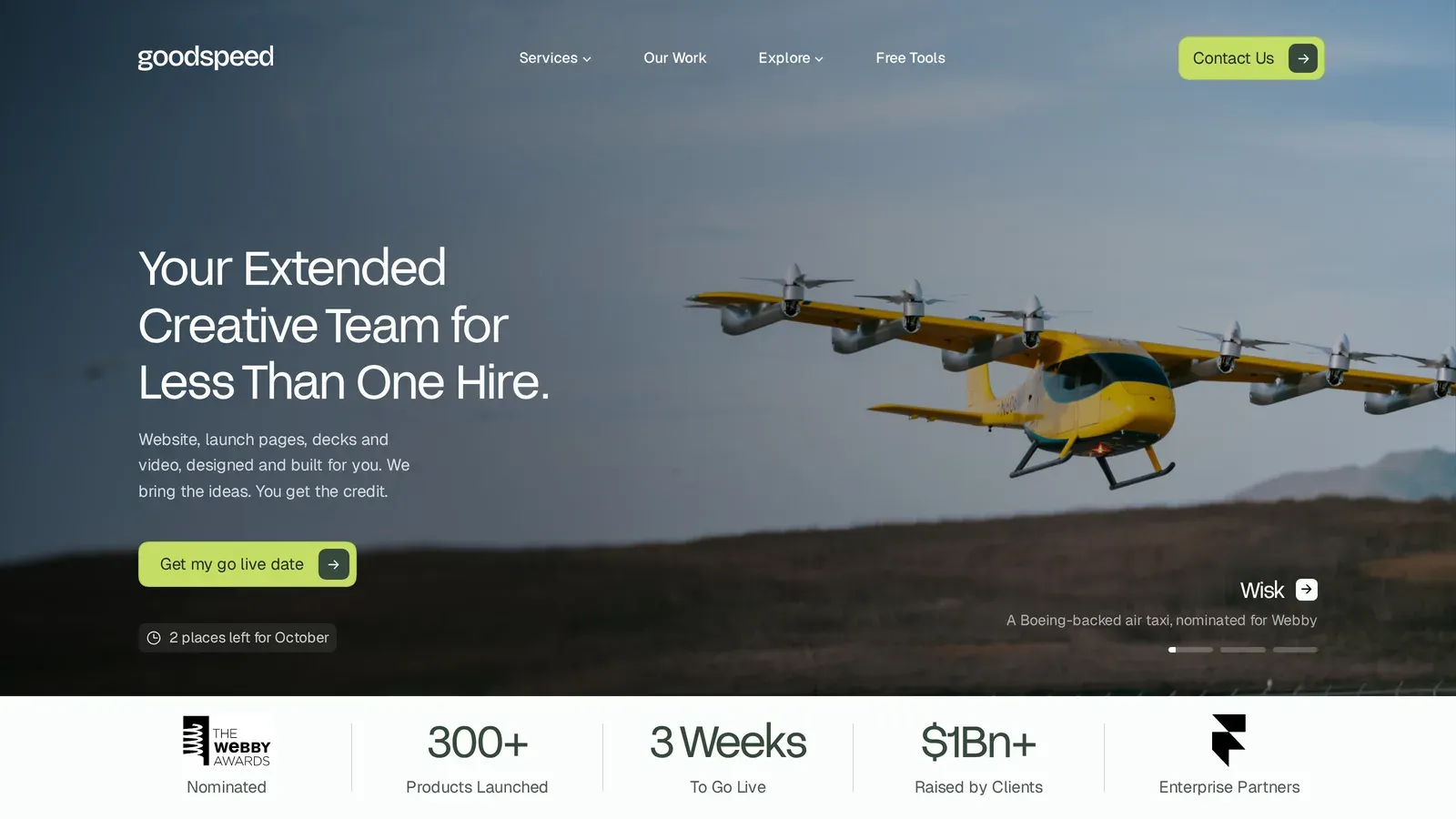
Goodspeed is a London studio of about 20 people, founded in 2022. Clutch rates it 5.0 across 47 reviews, with a $5,000 minimum. For Pickles, a London vet practice, it built a Bubble platform for bookings, prescriptions and billing, connected to Covetrus, Zoetis and Stripe: “The three hours of daily admin are gone.” For HubSync, a tax workflow platform, it built n8n automations and a two-way HubSpot sync that migrated 306 deals. There are caveats. Much of its internal-tool work runs on Bubble, where the code can’t be exported, and its homepage now sells website packages. Reviewers in 2024 and 2026 asked for more testing before handover.
Best for: founder-led SMEs that want a Bubble or n8n ops system and will handle their own QA at handover.
2. Itransition

Itransition is a firm of 3,000+ people, founded in 1998, with its main office in Decatur, Georgia, and another in Vilnius. Clutch rates it 4.9 across 42 reviews, with a $25,000 minimum. It has no internal-tools page, but three named cases involve internal systems: an Odoo order and inventory system for Temperley London (“50% costs saved on managing 15,000 products”), a Dynamics 365 finance platform for Kaskara Commodities connected to its Ignite CTRM system (onboarding a new entity fell from up to eight weeks to four days), and a loan platform for Belmont Finance. The caveats: it’s a 3,000-person enterprise firm, its internal-tool cases are mostly ERP builds (Odoo, Dynamics 365), and its Clutch profile has a long history but old reviews, dating back to 2014.
Best for: mid-market and enterprise companies that want a system built on or connected to an ERP or CRM.
3. PLANEKS
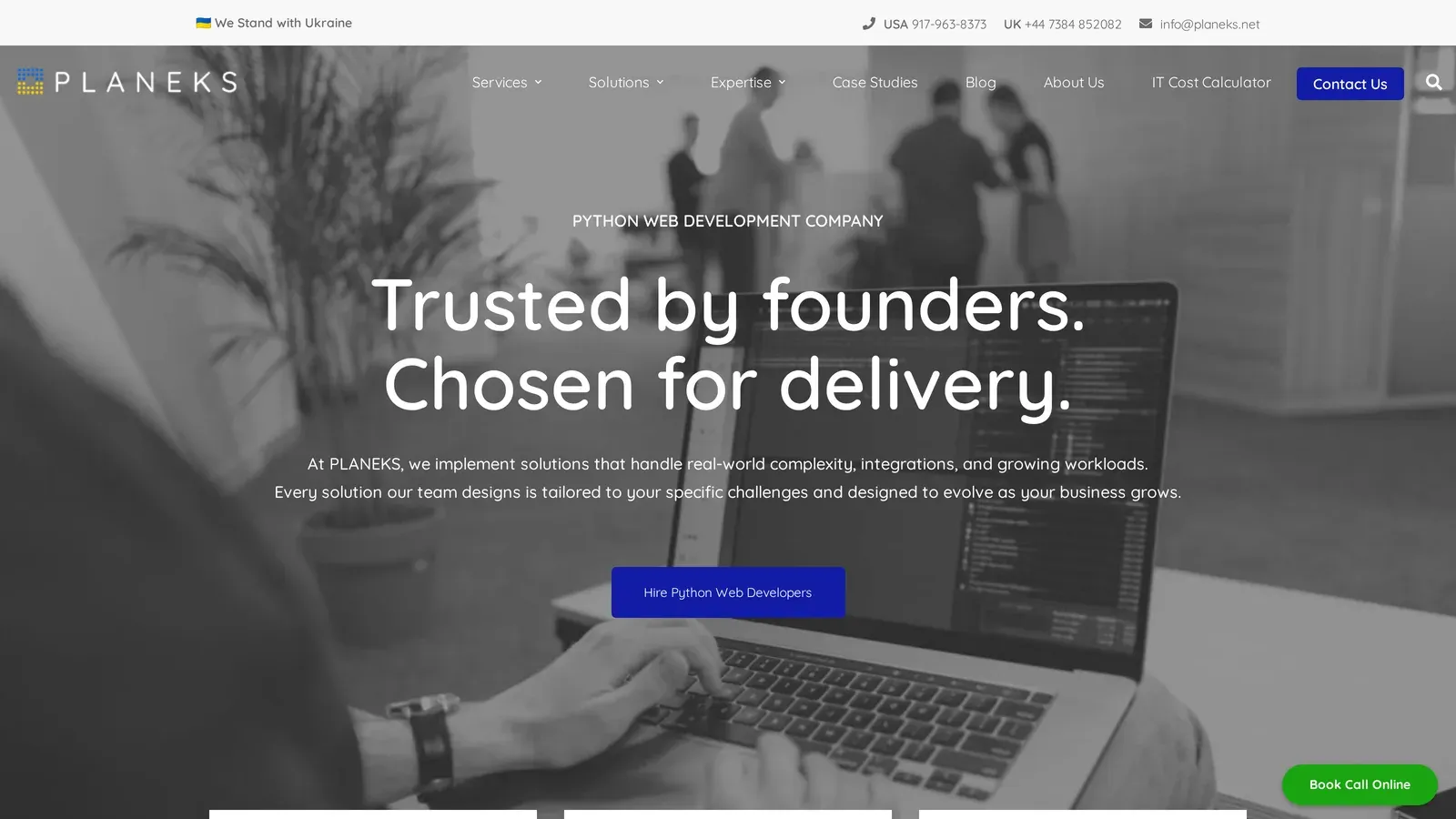
PLANEKS is a Python and Django shop founded in Ukraine, with a London address on its site. Clutch lists Kyiv as its headquarters and rates it 5.0 across 37 reviews, with a $10,000 minimum. Its two named cases look several years old: EuropaFoodXB, a staff CRM and delivery system that exports to DPD, and Wilhelmsen’s Spark app for fleet fuel use. The clearest recent proof is on Clutch. In August 2025, Nucar’s president described two internal apps for a car dealership group, with about $75,000 spent. PLANEKS publishes cost examples ($15K-$30K for a SaaS MVP with a basic admin panel, $80K+ for an enterprise system with ERP/CRM connections) and says clients keep the source code and IP. A 2023 reviewer called it their best offshore experience yet, while noting “some gaps around communication and expectations for deliverables.”
Best for: SMEs looking for a Python or Django ops system in the $10k-$80k range, with ownership in writing.
4. Magora
Magora is a London agency that has been in business since 2010, with 50+ engineers, designers and PMs. Clutch rates it 4.7 across 75 reviews, with a $10,000 minimum. Its prices are unusually clear: a free coded prototype in 5-10 working days, discovery from £3,000, a first release from £10,000, and a full system at £25,000-£60,000. Its FAQ says “source code, designs and IP transfer on payment.” Named internal-tool cases include EGIS’s Pharm Card app, which replaced hundreds of Excel files, and AstraZeneca’s finance dashboards. Neither case names a connected system, so Magora scores 1 there. Real ops systems will likely cost more than the “from” prices: Clutch’s most common project size is $50,000-$199,999. QA is the recurring complaint in reviews.
Best for: UK SMEs that want published prices, a prototype first and clear code ownership.
5. Inoxoft
Inoxoft has five offices, including Philadelphia, Wrocław, Tallinn and Lviv. Clutch lists a team of 50-249 people, founded in 2014. Clutch rates the company 5.0 across 74 reviews (its own homepage still says 50), with a $25,000 minimum and a $25-49 hourly rate. Its internal-tool case studies are all anonymous: a 1C accounting system connected to a custom warehouse system for a US fintech business, a “Smart Enterprise System” for a US logistics company, and a staff portal for an amenity-management company. Its education page says the source code and IP are “yours from day one.” Caveats: no named internal-tool clients, few metrics, and a newest Clutch review dated November 2025.
Best for: mid-market companies with $25k+ that are comfortable with Clutch references instead of named case studies.
If you’d rather see the plan and a fixed price before choosing a company, a Design & Architecture Sprint costs a fixed €7-15k over two to four weeks. The blueprint is yours to take to any company on this list.
6. Imaginary Cloud
Imaginary Cloud is a product studio founded in 2010, with offices in London, Lisbon and Coimbra. Clutch rates it 4.9 across 35 reviews, with a $25,000 minimum. It doesn’t offer an internal-tools service, but its named cases include Advania’s Reproduction Process System, built for a service center designed to process one million devices a year; a custom back office for Eurofound’s MPI tool; and an AWS workflow service for Sedna. It also designed, but didn’t build, a back-office app for UNUA, a made-to-measure tailor. The Advania case gives no outcome numbers and calls its connections only “existing systems,” so Imaginary Cloud scores 1 there. The budget may be a stretch in practice: its own site puts an average web app at $150,000-$400,000. Its Clutch reviews for internal-tool-style work date from 2020 to 2023.
Best for: scale-ups with a six-figure budget that want a design-led EU team to modernize an operations system.
7. Akveo
Akveo was founded in 2015. Clutch lists Austin as its headquarters; its site lists offices in Warsaw and Vilnius. Clutch rates it 5.0 across 31 reviews, with a $10,000 minimum. Akveo has a dedicated Retool page and named cases: E.ON Drive’s charger-monitoring dashboard across 11 countries (screen refresh time fell from over a minute to under 5 seconds, with tickets created in Salesforce), L’Esperta’s trip-operations app (120 hours a month saved), and a legal-document workflow for UNHCR. Its homepage says AI work typically costs $15K for a proof of concept and starts at $60k for a production build (3-5 months). The Retool page gives prices on request. The site never says who owns the code, costing Akveo a point. It also has a Vilnius office, so it competes directly with Idea Link.
Best for: ops teams looking for a Retool-first tool, from a small fix to a full production build, with IP terms agreed in writing.
Companies scoring 10
8. Atomic Object
Atomic Object is an employee-owned firm founded in 2001 in Grand Rapids, Michigan. Clutch rates it 4.9 across 52 reviews, at $150-$199 an hour. Its site says projects “usually run 3-18+ months, with a budget of $50k to over $1 million,” which costs the company a budget point. Two named cases involve internal systems: the National Center for Drug Free Sport’s SCAN 3, an iPad app plus an admin web app that replaced a decade-old testing system, and Masterpiece Flower Company’s ERP replacement. Neither case names a connected business system. On Clutch, a janitorial company’s CEO said, “We spent around $1.2 million on this project.” The site says, “All the intellectual property (IP) belongs to you.”
Best for: US mid-market companies with $50k or more that want a senior team to replace a legacy ERP.
9. DOOR3
DOOR3 is a New York technology consultancy founded in 2002. Clutch rates it 4.9 across 48 reviews, at $100-$149 an hour with a $25,000 minimum. It has a page for custom web and intranet portals, plus intranet-heavy references: Cadwalader, Wickersham & Taft’s firm-wide intranet for 400 lawyers, PRISM Vision Group’s SharePoint Online intranet, and Stillwell-Hansen’s Access-to-web rebuild. Its internal-tool reviews involve big budgets: Stillwell-Hansen’s VP of Operations wrote, “The project cost over 1 million.” The drawbacks: no published price, ownership is only implied, and the five newest Clutch reviews (February 2025 to January 2026) cover four design-only jobs and one MVP build for a startup. None is a recent reference for an internal-tool build.
Best for: law, finance and healthcare firms looking for an intranet or an Access-to-web rewrite, with a budget well above $25k.
If you’re not sure what to ask these companies for, our Design & Architecture Sprint maps how the work runs today and ends with a fixed build quote.
10. Velvetech

Velvetech is a US firm founded in 2004, with 250+ employees listed on its about page. Clutch rates it 5.0 across 22 reviews, with a $25,000 minimum, but all 22 reviews date from April 2018 to July 2023. Its own site offers better evidence: named back-office cases for US SMEs connected to QuickBooks. KKworx got a Creatio CRM connected to QuickBooks and Microsoft Exchange, while Leider Greenhouses had its 30-year-old plant production system rebuilt as a cloud app. Its FAQ says “the client owns the intellectual property, source code, and final deliverables.” The gaps: no prices or rates on the site, no page labeled internal tools, and no new Clutch review in over three years for a 250-person firm.
Best for: US SMEs with $25k+ that want a long-term partner to modernize an ERP or CRM back office.
11. Idea Link
Idea Link is a Kaunas-based software company founded in 2019, with an in-house team of 20+. Clutch rates it 5.0 across 17 reviews, with a $5,000 minimum. It publishes a fixed €7-15k Design & Architecture Sprint, a build floor of €20K-40K and a written IP transfer clause. Its named proof of internal-tool work is one case, Open Infra: an operations system with GPS tracking and work schedules for a fiber and electrical infrastructure operator, replacing several disconnected tools. That’s why it scores 1 for proof. A roadside-assistance dispatch system and an insurance partner portal are anonymous, and no case study names an existing system the tool connects to. The qualifying builds run on Bubble and Xano, the same caveat as Goodspeed: you own the app, but the code isn’t portable. Reviewers asked for more documentation (Open Infra, 2022) and more detailed scoping (Avance, 2024).
Best for: growing SMEs without developers that want a fixed-price plan before a modular build.
12. Razoyo
Razoyo is a small Texas team, listed on Clutch as having 2-9 people, and was founded in 2011. Clutch lists 5.0 across 3 reviews, at $150-$199 an hour. Its pricing page gives specific figures: a System Spec for a fixed $2,500, a working MVP from $5,000, and a production build from $10,000. The company says, “Once fees are paid, you own the code we write for you.” Its named internal-tool case is X10’s inventory system, which uses M2E and Embedded ERP to link X10’s sales platforms to factory-order data. No results are published. An anonymous B2B order workflow connects to the client’s legacy Sage ERP. Caveats: most of the portfolio is Magento and BigCommerce e-commerce, all three Clutch reviews were posted within two weeks in September 2026, and one says the project went well past its original estimate. Another notes, “sometimes, things just take longer.”
Best for: B2B companies with a legacy ERP that want a small senior team to spec a back-office layer first.
Companies scoring 9 or less
13. HouseofMVPs
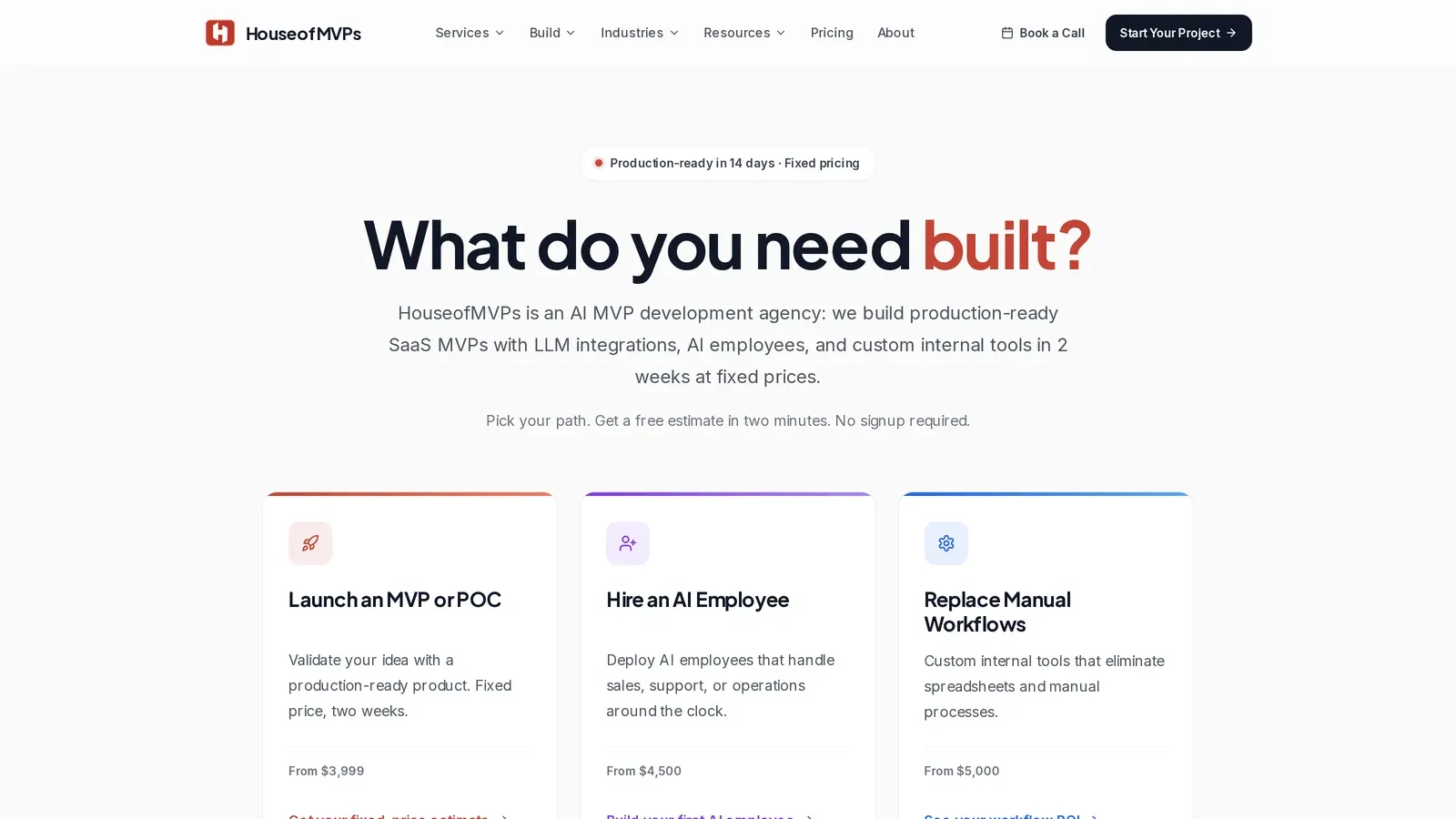
HouseofMVPs has a dedicated internal-tools page with fixed packages: $5,000 (10 days), $12,000 (3 weeks) and $25,000 (4-6 weeks). Each build “ships with full source code ownership.” Its four internal-tool case studies list exact prices and timelines (a custom CRM at $7,499 in 14 days, an inventory system at $12,999 in 18 days), but every client is confidential, so you can’t check the references independently. The site gives no location or team size. Clutch lists a 2-9 person studio founded in 2020 in Dindigul, India, with a profile that has no reviews. Its mid-tier price differs between pages ($12,000 and $9,000).
Best for: small teams that want one defined tool delivered fast for $5k-$25k and don’t need references before signing.
A fixed-price Design & Architecture Sprint ends with screens, architecture and a quote you can show to any company on this list, including ours.
14. Stackdrop
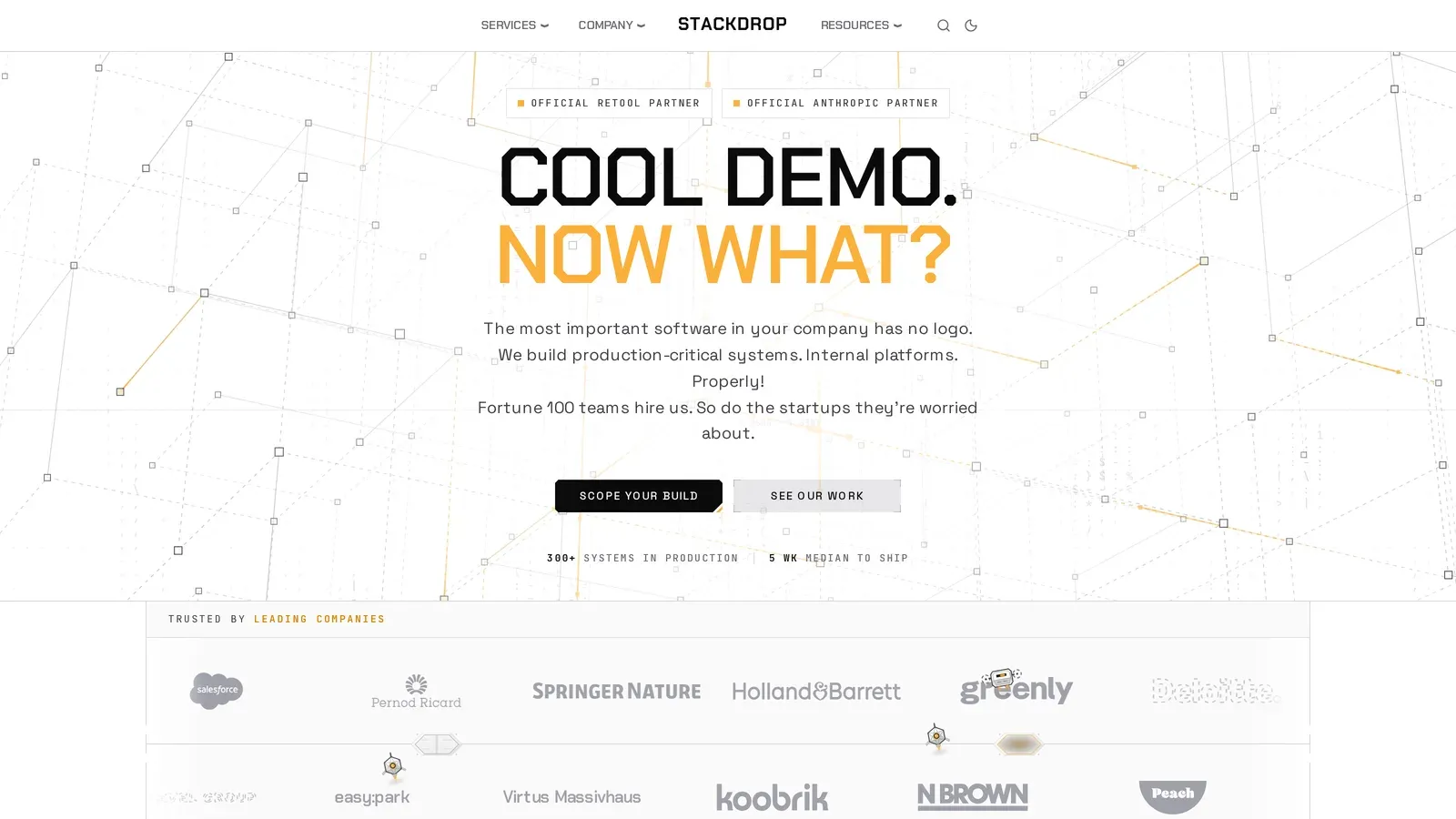
Stackdrop leads its homepage with internal tools (“Admin panels, portals and ops consoles”) and builds on Retool. It lists 20+ specialists and, according to Clutch, was founded in 2022 and is based in Kallithea, Greece. Its Clutch profile has no reviews. Saxo Bank’s Launchpad is a governed Retool platform for in-house creative operations, connected to Zuuvi, Bynder and Podio. Saxo’s own analysis shows average project duration falling from 310 hours to 67. Stackdrop says it has a median of 5 weeks to ship a first build across 200+ internal tools. The gaps: no prices or minimums anywhere, which is why it scores 0 on both, and no public reviews. Its ownership wording (“Your logic in your repo”) is clear enough, but it isn’t contract language.
Best for: regulated UK and EU teams that want a governed Retool build and are willing to run their own reference checks.
15. Bold Tech
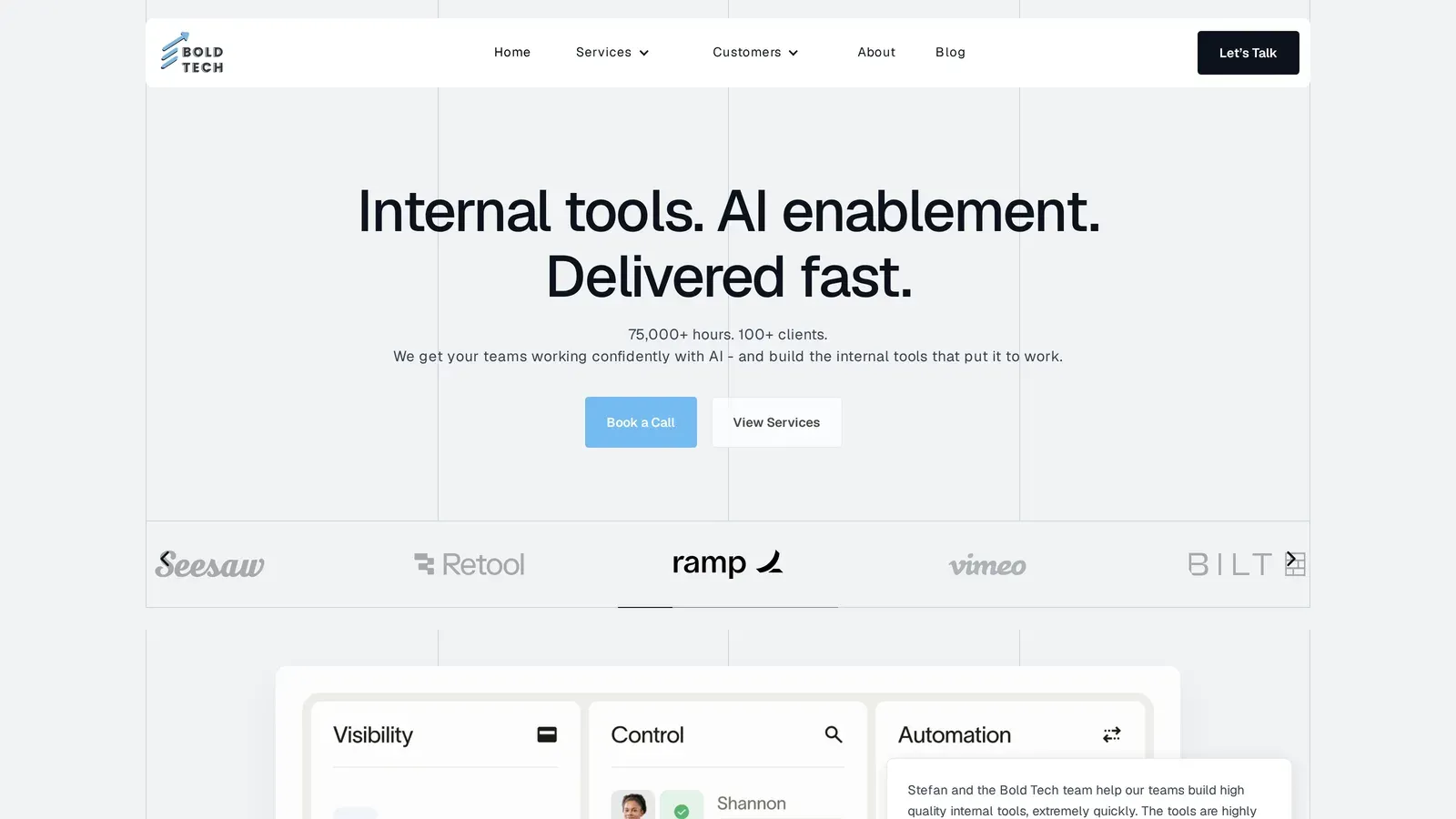
Bold Tech specializes in Retool. Its about page says the company has spent 80,000+ hours on internal tools since 2020 and profiles 12 people, but gives no address. We found no Clutch profile for it. The “Bold Tech” profile in Winter Park, Florida links to boldtech.co, and its reviews, dated 2013 to 2019, cover websites and mobile apps, so we didn’t count them. Its blog features named customer stories: Chegg Skills (internal Retool apps saving 80 hours a month on average), Vimeo (about 200 hours a quarter for one team) and One More Time VIP, a Retool operations database connected to NetSuite. The gaps: no prices, minimums or ownership statement, though its services page says each engagement “ends with a clean handoff.”
Best for: teams already using Retool that want a specialist to connect apps to systems such as NetSuite.
How to choose between them
Start with who will use the tool and what it needs to connect to. If the finance team uses it daily and it reads from QuickBooks, look for a company with a named QuickBooks project behind it. Velvetech publishes one (KKworx). Itransition publishes similar work for Dynamics 365 and Odoo. Then check five things.
- Named clients. Eleven of the 15 name two or more internal-tool clients. Ask to speak with one.
- Review dates, not just ratings. Every rated company sits between 4.7 and 5.0. Velvetech’s newest review is from July 2023; Inoxoft’s and Idea Link’s are from November 2025.
- Connections, named and written into the scope.
- Code ownership, and whether the code can leave the platform it runs on.
- A fixed price for a scoped first step. Eleven of the 15 publish some price on their own sites. DOOR3 and Velvetech show a price only on Clutch, while Stackdrop and Bold Tech publish none.
Building in-house makes sense when you already employ the developers and the tool is central to what you sell. For a team with no engineers, the Exclaimer numbers above are a reason to be careful.
What internal tools cost
These are the prices companies publish, in their own currencies, checked on 27 October 2026. Most are “from” prices.
- Razoyo: spec $2,500 fixed, MVP from $5,000, production build from $10,000.
- Goodspeed and HouseofMVPs: fixed sprints and packages from $5,000.
- Magora: discovery from £3,000, a full system at £25,000-£60,000.
- Idea Link: Sprint at a fixed €7-15k, builds from €20K-40K, up to €100k+.
- PLANEKS: $15K-$30K for a SaaS MVP with a basic admin panel, $80K+ for an enterprise system with ERP/CRM connections.
- Akveo: AI work typically costs $15K for a proof of concept, and starts at $60k for a production build. Its Retool page gives prices on request.
- Atomic Object: $50k to over $1 million. Imaginary Cloud: an average web app at $150,000-$400,000.
Clutch hourly bands range from $25-49 (Itransition, PLANEKS, Inoxoft) to $150-199 (Atomic Object, Razoyo). Treat “from” prices as floors. Magora’s most common reviewed project, for example, is $50,000-$199,999. Then there’s the bill after launch. In Exclaimer’s survey, 63% of teams spend 10-50 hours a month maintaining internal tools, and 66% need an additional $20,000 to $100,000 a year to keep them running. Exclaimer sells software, so keep that in mind when reading the figures.
About Idea Link
Idea Link is a Lithuanian software company founded in 2019, with offices in Kaunas and Vilnius. Our in-house team of 20+ has shipped 100+ digital and AI projects, and we hold a 5.0 rating on Clutch across 17 reviews. Start with Open Infra, an operations system for a fiber and electrical infrastructure operator that replaced several disconnected tools. Before any build, we offer the Design & Architecture Sprint, a fixed €7-15k engagement. You own the designs and code, with no license fees. More on our services page.
Frequently asked questions
What does an internal tools development company do?
It builds the software your staff use to run the business: back-office and operations systems, admin panels, internal dashboards, and staff or partner portals. The better companies also connect the tool to systems you already use, such as QuickBooks, Salesforce or an ERP, and hand over the code and documentation. A platform like Retool is different: you build on it yourself.
How much does a custom internal tool cost?
Published starting prices on this list range from a fixed $2,500 spec (Razoyo) and $5,000 packages (HouseofMVPs) to $50k and above (Atomic Object). Magora publishes £25,000-£60,000 for a full system, and PLANEKS lists $15K-$30K for a SaaS MVP with a basic admin panel. Ask for a fixed quote after scoping. “From” prices are floors.
Should I use Retool or hire a company?
Use a platform if one team needs a simple tool on one or two data sources and someone on staff will own it. Hire a company when the tool needs to connect to an ERP or accounting system, has many roles and permissions, or must keep working after its builder leaves. At Retool’s list prices, 5 builders and 100 internal users on Business cost $21,000 a year in licenses.
Who owns the code of an internal tool?
It depends on the contract, so get the terms in writing. Twelve of the 15 companies state client ownership on their own sites, though Stackdrop uses plain repo-and-handover language rather than IP terms. Akveo, DOOR3 and Bold Tech only imply ownership. On Bubble, which Goodspeed and Idea Link use for much of this work, you own the app but can’t export the code.
How long does an internal tool take to build?
Anywhere from days to months. HouseofMVPs lists 10 days to 6 weeks for its fixed packages, Magora offers a coded prototype in 5-10 working days, and Stackdrop reports a median first build of 5 weeks across 200+ internal tools. Akveo lists 3-5 months for an AI production build. A two-to-four-week Design & Architecture Sprint comes before the build.
The first step
If your operations live in Excel, email or someone’s head, and you’d rather see the plan and price before choosing a build partner, start with our Design & Architecture Sprint: a fixed €7-15k over two to four weeks that ends with a process map, architecture, screens and a fixed build quote. You own all of it, whether you build with us or not.
Related reading
- The best custom software development companies
- The best software development companies
- Nearshore software development companies
- The best AI agent development companies
- The best software development companies in Lithuania
- Our services
What changed in this update
- 27 October 2026: first published.